Cleaning Business Marketing: How to Leverage Workplace Safety

Commercial cleaning companies do more than improve a building's aesthetics. They improve also improve the health and safety of the workplace.
It's an important distinction because private employers report nearly 4 million nonfatal injuries each year. More than half require days off work, job transfer, or restricted duties, which has a major impact on the bottom line.
Occupational injuries and illnesses cost U.S. employers $225.8 billion in lost productivity annually. About $60 billion of that total is related to injuries and $150 billion is due to employees working while sick.
Maintaining a healthy and safe work environment can reduce these costs. That's where your company comes in. Focusing on how your services can improve workplace health and safety (and, therefore, boost the bottom line) is a smart marketing tactic.
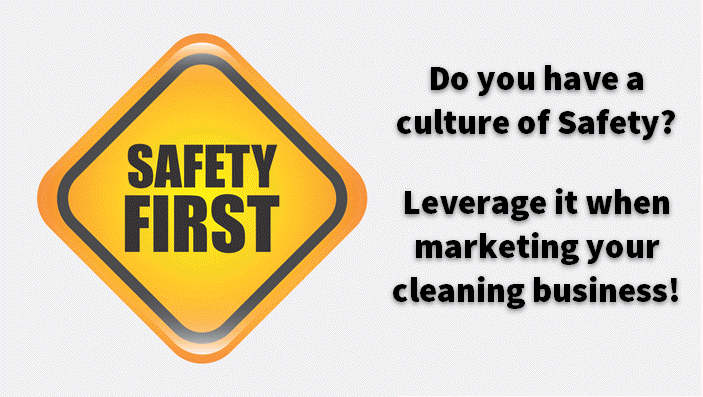
Tips for Marketing the Benefits of Safety in the Workplace
How a Safety Conscious Cleaning Company Prevents Slips, Trips and Falls
Falls accounted for $17.1 billion of the total costs associated with workplace injuries. Slips and trips without a fall made up another $2.3 billion. A clean facility has fewer slips, trips, and falls.
Clutter, dirt, and water can hide dangerous hazards. A commercial cleaning company reduces associated risks by keeping floors clean and dry.
Of course, it's important to choose the correct equipment and chemicals for each flooring type, and train your employees to use them properly. Improper cleaning can damage the floors and potentially increase the risk of trips and falls rather than reducing them. Also, make sure employees use signage when cleaning so employees don't unknowingly slip and fall on a wet floor.
Commercial cleaning contractors can further reduce accidents by encouraging their clients to invest in sufficient matting. Good matting, installed correctly, can prevent slips, trips, and falls by reducing the amount of dirt and moisture that is tracked across floors (about 80% of the soil in a building is tracked inside on people's shoes).
Talk to facility owners and managers about creating a “walk-off” area of at least 10 feet and as much as 40 feet of matting. This includes a scraper mat (outside), a scraper/wiper, and finally a wiper mat. Mats should be installed at all entrances.
Make sure the matting doesn't curl and cause trips by using double-sided adhesive along the edges. Also, create a maintenance program that includes regular vacuuming and deep cleaning of mats to keep them working effectively.
Finally, contract cleaning companies can also play a part in properly disposing of trash so they don't cause accidents. Train your employees to regularly inspect for these hazards, as well as potential dangers like tangled cords and stacks of boxes.
Good Lighting Improves Safety Awareness
Janitors often overlook windows and light fixtures as they clean a workspace. That's a mistake because reduced lighting can be potentially dangerous. Employees working in an area with burned out lights can harm their ability to perform their work effectively. For those working on computers, it can also do damage to eyes due to eye strain.
A dust-covered window or light fixture makes it more difficult for an employee to perform their tasks, which can reduce productivity. Even scarier, dirty and dim windows and lights can result in accidents by making it difficult to see obstacles in a stairwell or hallway.
Include windows and lighting on your workers' checklist of routine cleaning tasks. Keeping them clean improves visibility and, in turn, safety in the workplace.
Cleaning for Health Improves Workplace Safety
The largest portion of costs for employee injuries and illnesses comes from sick employees, both those that call out of work (absenteeism) and those who show up (presenteeism).
Germs can quickly spread throughout a workplace, leading to missed workdays and decreased productivity. Proper cleaning processes can reduce the spread of contagious viruses by 80 to 90 percent, according to studies by University of Arizona microbiologist Dr. Charles Gerba.
Use a two-step cleaning process: Use a general-purpose cleaner to remove visible soil, then an EPA-registered, hospital-grade disinfectant to kill microbes that remain. In addition to surfaces like desktops, don't forget to also clean other frequently touched hotspots—computer keyboards, phones, doorknobs, light switches, and faucets.
Follow the disinfectant manufacturer's directions regarding dwell time to ensure it works properly. You can also prevent the spread of viruses (cross-contamination) by using clean, microfiber cloths that are color-coded tools for specific areas or tasks.
ISSA recommends at least once-daily cleaning and disinfecting of high-touch surfaces throughout the year. Most likely, though, those frequencies will need to increase during cold and flu season.
Of course, you aren't in your customers' buildings 24 hours a day. That means it's important to involve your customers in the process of reducing contamination and keeping buildings healthy. Work with the facility owner or manager to provide employees easy access to hand sanitizer and disinfectant wipes.
Go the extra mile (and really impress your clients) by putting up signs or circulating flyers that talk about how to use sanitizer and wipes to prevent the spread of illness. You can do the same to promote hand hygiene by hanging signs in the bathrooms, kitchens, and break rooms.
Sell Safety to Your Clients
Many facility managers and building owners are looking for ways to improve employee health and safety. They know that doing so will go a long way in boosting their bottom line. If you can clearly communicate how you can help in this effort, you are sure to stand out from the competition.
Marketing how your cleaning improves health and safety can be such a big differentiator that you may even be able to charge a higher rate.
For companies that don't yet understand the value of this type of cleaning, your job is to educate them about the ROI. Share statistics about the hidden costs of injuries and illnesses, and how a thorough cleaning program can save them money.
Taking the time to shed light on this issue (on your website, in your marketing materials and during sales calls) can open people's eyes. It may help them shift from thinking about cleaning as a line-item cost to a valuable piece of the cost-reduction puzzle.
Ebook Download: Make Your Contract Cleaning Business Stand Out From the Crowd
|
|
To survive in a crowded marketplace, you must differentiate yourself from every other BSC out there – you must make your contract cleaning business stand out from the crowd. This guide will show you how. |
Visit our Store for Certification Training Programs