

Planning for Emergencies in Your Cleaning Business

On an average day your staff will go to work and the time will pass routinely, without incident. But unexpected events will come up from time to time, so planning for emergencies will help reduce the stress when it does happen. Whether the incident is life threatening, the building loses electricity, or even a chemical spill on carpet, you need to make sure your staff is prepared and knows how to respond.
First, make sure you discuss emergency procedures with your client. They should have an emergency plan for their tenants and staff, and it should be shared with you and your employees.
What to do when the lights go out
Most commercial cleaning is done in the evening hours, so when the electricity goes out your staff will not be able to do their jobs. But that does not mean they should immediately leave the building and go home. We once had 3 employees in a building leave because the lights went out. They called after they got home, and when our supervisor went to the building the lights were back on. Turns out they were only out for about 15 minutes.
Many buildings have emergency lighting, which is helpful for employees who are deep inside the building when the lights go out. If the sun hasn't gone down completely, windows might provide enough light to help them get to the entrance. But if there is a chance they could find themselves in total darkness, providing flashlights is a good idea.
When the lights to out employees should contact their supervisor - before just leaving the building as they did in our case. Some buildings provide at least one phone that isn't connected to the electronic switchboard. If that's not the case, they should use their cell phone. If an employee does not have a cell phone, they should wait 30 minutes to see if the electricity is restored. If not, then they can leave the building and go to a phone to contact a supervisor.
In case of fire
Your cleaning crew should know where all fire extinguishers are located. They also need to know where emergency phone numbers are posted. If an employee comes across a small fire and have been trained on how to use a fire extinguisher, they should put it out and then call their supervisor. If they are unable to safely put out the fire, employees should immediately leave the building, call the fire department, and then their supervisor. The supervisor should call you and/or the company's contact person.
Mother Nature
Weather can impact your employees so they should know what to do in these situations.
- Blizzards and heavy snowfall. As most cleaning companies work in the evenings there is a good chance that your employees can get "snowed in". If your cleaning business is located in a part of the country where snow can be a problem, put together a plan to deal with snow emergencies. Make sure your employees know what is expected of them in case of sudden snowstorms.
- Heavy rainfall and flooding. If an employee is on their way to work in heavy rain and comes up to a flooded road, encourage them to find an alternate route. They should never try to cross a flooded area, as they can find themselves in a dangerous situation. Similar to heavy snow fall situations, you should have a plan for dealing with heavy rain and flooding situations and communicate that plan to your employees.
- Earthquakes and other natural disasters. Train your employees to remain calm in any emergency. They should also be aware of what the emergency procedures are for the buildings that they work in and follow those procedures.
Chemical spills
Cleaning companies deal with several different types of chemicals so your safety training program should include procedures on how to clean up spills. Cleaning technicians need to know what chemicals they are using, how to use them correctly and safely, where to find the SDS sheets and how to read them. No matter how careful your employees are when using and handling cleaning products, there can occasionally be a spill.
Many cleaning products contain chemicals that can cause burns, eye irritations or skin irritations. Personal protective equipment (gloves and goggles) are to be worn when cleaning up spills. If there is a small spill, wipe it up with a clean cloth and allow it to dry. Barricade anything that cannot be wiped up immediately. If you don't have any barricade tape, use a chair or something that is easily seen and that people can't walk through. Then go clean up the spill. The method for cleaning the spill depends on the chemical that was spilled. The product's SDS will contain information on how to clean up spills. If the employee has any question on dealing with a spill, he or she should immediately call his/her supervisor.
Slips and Falls
Slip and fall accidents are one of the most common in our industry. A cleaning technician could fall off a ladder when washing windows, or they could slip on a wet floor, which is the most common slip/fall accident. Again, safety training on how to avoid slip/fall accidents is key. Employees should understand ladder safety, including using extension tools instead of over-reaching. They should know not to walk across wet floors and to place barricades when cleaning floors.
That being said, slips and falls still happen. Often when someone falls they are embarrassed and want to act like nothing has happened. Encourage your employees not to move until they are sure they are okay. If necessary, they should call for help. Regardless of whether or not the employee feels they have an injury, they must be instructed to contact their supervisor immediately. A written accident report must be documented as soon as possible after the incident. This not only helps the company when dealing with Worker's Comp claims, but it can help identify potential hazardous conditions in the building that must be addressed.
Health problems on the job
We all know by now that we should encourage sick employees to stay home. You do not want them to spread any germs or viruses to other employees or occupants of the building. But there may also be sudden health problems that come up on the job that your employees should be trained to deal with:
- Choking. If an employee does not have first aid training and there is no one nearby that has first aid training, they should call 9-1-1 and ask for help.
- Heart Attacks. Make the victim comfortable and immediately call 9-1-1.
What to do when an employee breaks client property
Unfortunately things break. No matter if the item is small, such as a picture frame, or a large piece of equipment such as a computer, the broken item needs to be cleaned up. Have the employee leave a note with an explanation as to what happened and that your manager will be calling in the morning. The employee should then call his supervisor and explain what happened. If it happened during the night shift, be sure to call the minute your client's business is open to take care of the situation. Be sure to train your employees to report all broken items. They should never conceal the fact that they broke something, as that will make the situation worse.
No matter how careful we try to be, unforeseen events can happen. We hope that nothing will happen while our employees are doing their job - that they are always safe and sound. However, it pays to be prepared by having an emergency plan as part of your company's overall training program. Investing a little time to train and prepare your employees can pay great dividends.
Copyright The Janitorial Store. All Rights Reserved
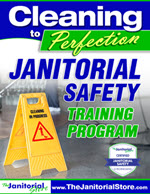
Certified Safety Training for Janitorial Employees
Janitorial safety training must be a priority in your cleaning business. Not only is it your responsibility to keep your employees safe, but paying added Worker's Compensation fees due to your own lack of training just does not make good business sense.
Buy the Training Program and learn how to use it to get Certified!
Visit our Store for Certification Training Programs





