


How to Start a Cleaning Business - Part 4 - Business-Planning
Business Planning for Start Up Cleaning Companies
This is Part 4 of our series on starting a cleaning business
As you progress towards opening the doors to your new business, you must prepare a business plan for your new company. There are numerous details involved in creating and preparing this business plan and you should take these steps very seriously. The success of your new business will depend on it!
As you think about starting a cleaning business, have you thought about how much money it will take to get started? By taking the right steps at the beginning, you can start your cleaning business with very low up-front costs, and, unlike many small businesses, you can actually clear a profit in your first year of operation!
"If you are failing to plan, you are planning to fail". Tariq Siddique
What are the advantages of starting a cleaning business as opposed to owning and operating another type of business?
- A successful cleaning business can easily be started by one person who does everything from billing to marketing to the actual cleaning. If needed, you can start the business part-time and keep a full-time job until the business grows and can support your lifestyle, but it can be a difficult balancing act.
- You'll provide the cleaning services at the client's building, so more than likely clients will never go to your "place of business". Therefore, you can easily run a commercial cleaning business out of your home. A spare room or garage can hold your supplies and equipment, and you can use a spare bedroom or small corner of any room to do your paperwork. Working out of your home saves the cost of leasing or owning a building and you may qualify for tax deductions if you have dedicated space for your home office. Be sure to consult with your accountant to see if you are qualified.
- You can start a cleaning business with only a small investment in supplies and equipment. As your business grows and you offer more services such as carpet cleaning or stripping floors, you can buy or lease equipment.
- When just starting out you will probably do most, if not all, of the work by yourself. If you need employees you can start by working with a temporary employment agency and avoid the challenging tasks of payroll and paying employment taxes, social security, unemployment, and worker's compensation.
- A cleaning business can start out as a sole proprietorship, which is the easiest and cheapest way to set up a business entity. As the business grows you can consider changing the structure to a corporation or limited liability corporation, which may require an attorney and an investment of several hundred dollars.
Steps needed to not only start a cleaning business, but to make sure that it is a successful cleaning business
1. Begin by writing a business plan. This does not have to be a long document, but a three-to five page document that you prepare to help you focus and decide the basic parameters of your cleaning business. Include the following in your business plan: business name, location, geographic area you will serve, competition, business structure, marketing plan, accounting procedures and a cash flow spreadsheet. Remember, a business plan is to help get you focused - it is not a hard and fast document that outlines the day-to-day operations of how you will run your cleaning business.
2. After deciding on a business name and business structure, it is important to decide on a particular "niche" for your cleaning business. Do you want to clean small office buildings, large office buildings, medical clinics, banks, and new construction or government buildings? It is much easier to start with one particular niche and focus your marketing efforts on a select group, rather than spreading yourself too thin.
3. When just starting out your cleaning business you can easily operate on a shoestring marketing budget. Avoid the expensive and often ineffective newspaper and radio ads. Market your cleaning services through networking (especially through your local chamber), talking to property managers, and watching for new buildings going up in your area.
4. Once you decide to start a cleaning business, develop a relationship with a janitorial supplies distributor. Although it may seem like buying supplies through a distributor is more expensive than buying through a "big box retail store", there are many advantages in working with a distributor. A distributor can teach you how to use supplies and equipment properly, which will save your cleaning business time and money.
A distributor has knowledge of new products and can let you know when a cheaper product works just as well as a more expensive item. Through a distributor you will be able to buy concentrated and more effective cleaning chemicals. Knowing what chemicals to use and how to use them can directly affect your bottom line. This is advice you cannot get from a big box store! And besides giving advice and training, a janitorial supplies distributor may have leads and referrals that can lead to profitable cleaning accounts.
5. Another important person to find right at the start of your cleaning business is an accountant. A good accountant does much more than figure out your taxes at the end of the year. He or she will provide financial advice and guidance throughout the year and help you make important financial decisions such as when to buy or lease a piece of equipment or whether you should rent office space. This will help to save you money.
Hard work, dedication and attention to detail will keep your cleaning business going. Taking the time to make plans for your cleaning business will help to ensure that your cleaning business is successful!
Finance Your Cleaning Business by Bootstrapping
New cleaning businesses tend to have few financial resources.
Before you sign your first client you need capital for supplies, equipment, basic start-up expenses, and perhaps even payroll. Where do start-up companies get the financing they need to set up shop? Some businesses use savings, some borrow from friends or relatives, and some get a bank loan. But many small start-ups rely on a technique called bootstrapping.
Bootstrapping means pinching pennies, cutting corners, and learning to do more with less.
Using bootstrapping techniques also means carefully watching where your cash is coming from and where it is going to. Does this technique work for growing your business? You bet! Ernest & Julio Gallo, Domino's Pizza, Hallmark Cards and Black & Decker are examples of businesses that started with $1000 or less and used the art of bootstrapping to grow and become successful.
In bootstrapping you not only focus on how revenues come into the business, but where you are going to spend the money that comes in and if there are other ways to obtain those resources.
The following are techniques that have helped businesses grow and expand.
1. Focus on the right customers. Some customers like to hold onto invoices as long as possible. Finding customers who pay immediately helps keep cash flowing into your cleaning business. Maintaining a good customer relationship will also help to get your customers paying as soon as they get their invoice.
2. Be frugal, but not cheap! Distinguish between costs that are necessary and ones you can avoid. Do you need to rent space for your cleaning business or can you begin by running the business out of your home or garage? Can you get by with used equipment? Do you need a cell phone with streaming video or just a basic model to make sure you do not miss any calls? On the same token, don't be shortsighted (and cheap) with suppliers. Develop a good relationship with your suppliers and they will be happy to let you know when there are specials and if a lower priced item works as well as a more expensive one.
3. Create a high profile for your cleaning business. By taking on larger cleaning accounts your business projects an image of competency and that it has the skills and resources to handle the job.
4. Keep your salary as low as possible. The less cash that goes out of your business the better. Cut back on your personal expenses while the business grows. Avoid buying that new car and that holiday cruise until your cleaning business has a good cash flow.
5. Get your customers talking about you. Word of mouth is the best advertising around and it doesn't cost you anything. Ask your customers for referrals and tell them to mention your name if they know of anyone who is looking for cleaning services.
6. Keep good records and track every dollar. It is difficult to know if there are expenses that you can cut if you don't know where your money is going or where your money is coming from. Keep more income by not giving preferential treatment or discounts to special customers.
7. Barter for services. Are there individuals or businesses that would be willing to have you clean their offices for part or all of their payment? Large businesses and corporations may not have the flexibility to "swap" services, but your lawyer, graphic designer, accountant or other consultant may be happy to exchange services.
8. If you need employees, hire part-time or temporary help. Rather than having a full-time bookkeeper or marketing person think of hiring a virtual assistant that you can pay for just a few hours a month. Another benefit to a virtual assistant is that she will have her own equipment and be responsible for her own employment taxes.
9. If you are buying or leasing space and equipment agree to only short-term leases. This helps you control costs and keep your cash flow flexible.
10. How much inventory do you need to have on hand? Don't tie up money in supplies and equipment that will just be sitting on a shelf.
11. If necessary, work nights and weekends while your business is growing. Many entrepreneurs will keep their full-time job and a part-time job until their own business is financially stable.
Using bootstrapping techniques mean that you are looking at more than just where your money is coming from. Earning a dollar in revenue may lead to only 20 cents in profit. But if you save a dollar in cost savings, that goes 100 percent to your bottom line. Being frugal at the start of your business can pay big dividends in the long run. Bootstrapping can be your best friend when it comes to the cash flow of your cleaning the business!
7 Advantages to Leasing Equipment for Your Cleaning Business
All small businesses need equipment and your cleaning business is no exception.
But you don't necessarily have to buy the equipment to run your cleaning business successfully. Depending on your circumstances, leasing may be a better choice than buying every piece of equipment you need for your cleaning business.
What is a lease?
A lease is an agreement in which you have the use of a piece of equipment, but you do not own it. The user (the lessee) makes payments to the owner of the equipment (the lessor). Leasing has become a common business practice. The U.S. Small Business Administration (SBA) reports that equipment leasing has risen about 20 percent over the past two years. And, according to the Equipment Leasing Association, 8 out of 10 U.S. businesses lease all or part of their equipment.
There are several advantages to leasing equipment:
1. Leasing is flexible. As your business grows your needs may change. Leasing allows you to add or upgrade equipment. Lease terms vary from 12 months to 60 months. You may even be able to upgrade your equipment during the original lease period.
2. Capital conservation. In today's financial environment, you can lease equipment with little or even no money down. If you have to borrow money to buy a piece of equipment you may have to put money down that you could have used in other areas of your business, such as marketing or wages. Leases generally require little or no down payment so it is likely you may be able to get more equipment or higher quality equipment than you could by buying.
3. Fixed predictable payments. When structuring the payments of a lease, look for fixed, monthly payments. This will protect you against rising interest rates and help you to project your cash flow outlays.
4. Leasing is cost-effective. Equipment in itself is costly and can also incur unexpected breakdown or repair costs. Most leased equipment is maintained and repaired by the owner of the equipment.
5. Tax advantages. Operating leases are generally 100 percent tax deductible as a business expense and are paid out of pre-tax earnings instead of after-tax profits.
6. Not having to deal with obsolete equipment. In today's business society, manufacturers constantly upgrade equipment and add new features. By leasing you can always be using the most up-to-date equipment. You also are relieved of the problem of getting rid of an outdated piece of equipment.
7. Convenience. Applying for a lease is generally easier than applying for a loan. Loans generally require large amounts of paperwork and copies of financial reports or tax returns. A lease agreement typically involves a brief application form and may not require supporting financial documents.
Before leasing, go through the following list of questions from the Equipment Leasing Association:
Before Leasing:
1. How am I planning to use this equipment?
2. Does the leasing representative understand my business and how this transaction helps me to do business?
During
3. What is the total lease payment and are there any other costs that I could incur before the lease ends?
4. What happens if I want to change this lease or end the lease early?
5. How am I responsible if the equipment is damaged or destroyed?
6. What are my obligations for the equipment (such as insurance, taxes and maintenance) during the lease?
7. Can I upgrade the equipment or add equipment under this lease?
After
8. What are my options at the end of the lease?
9. What are the procedures I must follow if I choose to return the equipment?
10. Are there any extra costs at the end of the lease?
When leasing equipment it is important to understand the terms of the lease.
Getting answers to the above questions will help you get all the information you need about your lease and avoid surprises or hidden costs after you sign the lease.
With leasing you do not own the equipment, but your cleaning business has the advantage of using the latest equipment and staying on top of technological advances. With the many benefits of leasing, it may be a better choice for your company than the outright purchase of an expensive machine.
Why Your Cleaning Company Should Buy From Janitorial Distributors
There is no getting around it - your cleaning business needs high quality cleaning supplies and equipment so you and your employees can effectively do the job of taking care of your clients' buildings.
There are several places you can buy the chemicals you need to clean. Over 50% of the respondents to a survey done by TheJanitorialStore.com showed they buy their supplies from a big box retailer. But there is a better solution to buying cleaning supplies and equipment than purchasing Lysol, 409, or window cleaner from a large retail store. A janitorial supplies distributor can supply your cleaning company with professional products and much more.
At first glance the cleaning products bought through a janitorial distributor may seem to be higher in cost than the products bought from a big box retailer. However, the professional quality products you get from a distributor are higher quality products that clean better and more efficiently.
Distributors have products available in concentrated form, which means a small amount goes a long way. You'll actually be spending less than you would if you bought from a retailer. The price may initially seem higher, but once you see how far concentrates stretch just by adding water, you will see that buying cleaning products in a concentrated form is a bargain. Distributors may also offer quantity discounts for high volume purchases.
In addition to higher quality products and the ability to offer volume discounts, there are many other reasons that your cleaning business will benefit from doing business with a janitorial supplies distributor:
Distributors keep records of the items that you buy. They also keep track of warranty information. Distributors can also provide you with SDS sheets on the cleaning products that you buy from them. As you know, you're required to have SDS sheets on all cleaning chemicals you use and have them available for your employees. Most retailers won't be able to offer SDS sheets.
Janitorial supply distributors have in-depth product knowledge. Looking for a product to give your restrooms a "fresh smell"? Forget about buying Pine sol from a retailer. Pine sol has a strong smell that people may find offensive. A distributor will be able to recommend a suitable air freshener for your particular situation. A good distributor can recommend products and will know if a lower priced product is just as effective as a higher priced item.
Don't know how to use a cleaning product or piece of equipment? Your distributor will be able to train you and your employees on how to use new products and equipment properly. Your distributor will also be able to share information on how to use products that can help your staff become more efficient. Rather than saving just a few pennies by buying a product from a retailer, you can save a substantial amount in labor savings with the product information you can get from a distributor.
Equipment breakdown? Some distributors may even offer repair service for your cleaning equipment saving you the time and headaches of sending your equipment back to the manufacturer for repairs.
Do you need a specialized cleaning product for a building or job? Your distributor will have suggestions for the product you need and if he does not have it on hand will know where to order it from.
Pricing alone should not dictate where you buy the supplies for your cleaning business. The value you get by buying cleaning supplies from an experienced distributor is priceless. Rather than saving a dollar or two on cleaning products by buying through a big box store, you can save hundreds of dollars on staff time by working with your distributor. And those savings will lead directly to more profit in your pocket!
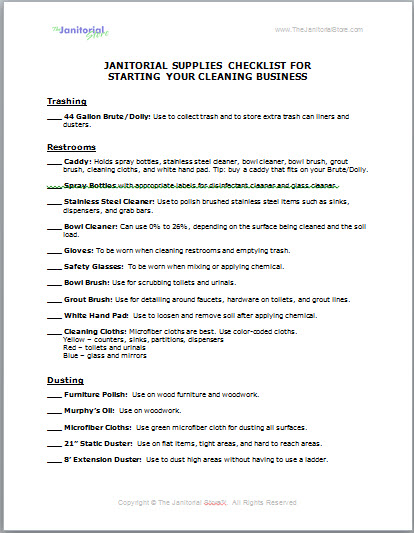
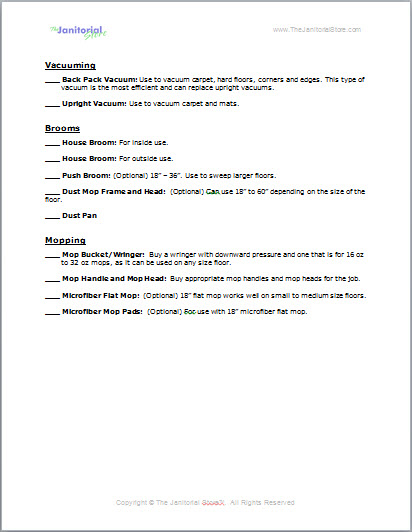
Janitorial Supplies Checklist for Starting Your Cleaning Business
Members: Download the Supplies Checklist
Use the following checklist when buying your cleaning supplies and equipment from your local janitorial supplier. This list gives a breakdown of the supplies you will need to have on hand to do the job. The list is broken down by task and also has a list of restroom cleaning supplies that you should have on hand.
In Part 5 you'll learn how to create a Business plan outline:
A business plan is a document that helps you to identify your business and the specific products and services that you are going to offer to your clients. In addition, a business plan makes you think through all of the legal and financial aspects of your business.
How to Start a Cleaning Business - Part 5 - Creating a Business Plan




