What is a PEO and How Can It Help My Cleaning Company?

As a contract cleaning business grows, the demand for human resources help also increases. When a dedicated HR professional or department isn't in the budget, outsourcing the work to a professional employer organization (PEO) can ease the burden.
A PEO assumes many employer-related HR responsibilities, such as payroll and benefits, for small and mid-size businesses. This contractual arrangement frees up the contract cleaning company's time to focus on finding and servicing clients.
The first time I was introduced to the concept of using a PEO to help manage the HR functions in our company I was skeptical. I had never heard of such a thing, and when you read on about how it works legally, you may be skeptical too! But before you discount it as not for you, consider the benefits. Years later weight on my shoulders has lightened exponentially when it comes to all things HR.
How does a PEO work?
Under a contract called a client service agreement (CSA), the PEO co-employs its client's employees and shares employer responsibilities with them. This is the scary part if you're just learning this for the first time. But keep in mind that you still have full control over your employees.
Typically, the PEO remits wages and withholdings for employees, collects and deposits employment taxes, and issues W-2s for the compensation paid by it under its EIN. The PEO should also provide a full HR package, including things like workers' compensation insurance and a range of employee benefits programs.
Depending on the contract, a PEO may maintain employee records, retain a right to hire and fire, and/or assist with workplace safety and compliance. The client retains complete control over day-to-day operations. In our case, we do all the hiring and firing and utilize our PEO for their expertise and advice when it comes to making decisions about employees.
Why use a PEO for Your Cleaning Company?
There are 907 PEOs in the U.S. that provide services to 175,000 businesses, which employ 3.7 million people. ?The average client is a business with 19 employees. However, companies as small as 3 employees and as many as hundreds can use a PEO service.
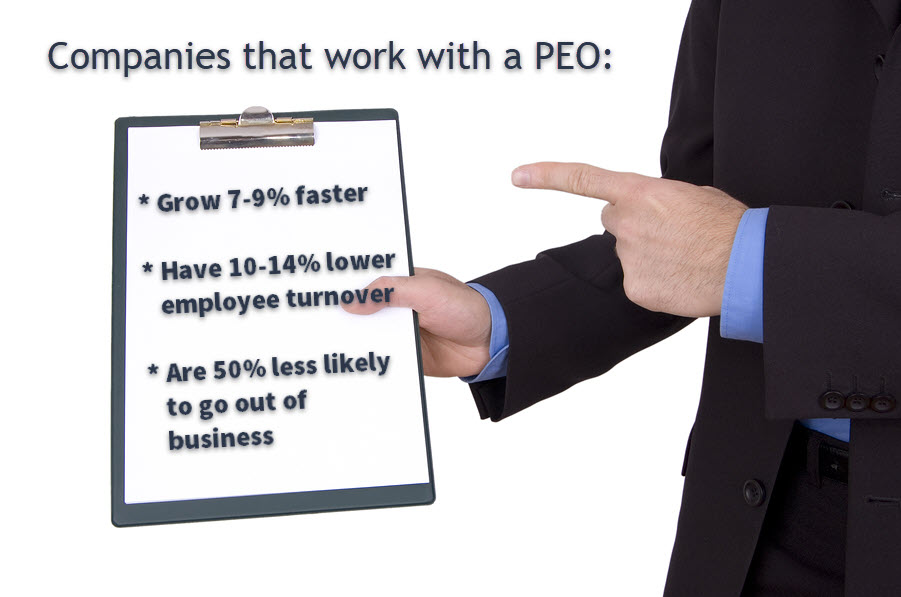
Why are PEOs becoming so popular? According to the National Association of Professional Employer Organizations (NAPEO), companies that work with a PEO grow 7 to 9 percent faster, have employee turnover that is 10 to 14 percent lower, and are 50 percent less likely to go out of business.
PEOs can provide HR services at a lower cost than is possible for an owner trying to juggle all facets of running a business. In fact, administrative costs are around $450 lower per employee for businesses that use a PEO.
Watch the Interview with a PEO Company to Learn More
Other pros of working with a PEO include:
Better Benefits
PEOs have access to group benefits typically not available to small businesses. This allows employees to enjoy big-business benefits like 401(k) plans, health insurance, medical and dental coverage, dependent care, a healthcare flexible spending account, and life and disability benefits. As plan sponsor, the PEO handles administrative tasks, such as negotiating with carriers and managing regulatory requirements. It also enrolls employees and educates them about their benefits.
We currently offer the following benefits with the help of our PEO: health insurance, vision insurance, short-term and long-term disability. We currently pay 50% of the health care premium for the employee and we pick up all costs for the rest because it's very affordable.
Less Risk
Employment laws change frequently, but failing to comply could result in a fine. The HR professionals in a PEO stay on top of the latest laws and regulations and help their clients avoid compliance mishaps. Also, a PEO shares in the liability associated with certain employment-related claims, including wrongful termination. Their experienced experts are also there to help mitigate potentially costly legal settlements.
Fewer Headaches
Dealing with workers' compensation insurance premiums and claims management is time-consuming and frustrating. As a co-employer, a PEO can provide workers' comp coverage to your employees through its program, and handle paperwork and compliance issues. This is what we do in our company.
Recruiting
Hiring the wrong person is costly, especially in an industry like contract cleaning where turnover rates are already high. PEOs may save you money by providing access to experienced recruiters who can size up your company's employment needs and help find the right candidates for key roles.
More Focus
Perhaps most important, by handing off HR responsibilities to a third-party contractor, a company can focus on its core mission. The client can maintain a simple in-house HR infrastructure or none at all, and use the time savings to improve productivity, find new clients, and grow the bottom line.
Hiring a PEO Company
PEOs operate in every state and, in most cases, charge in one of two ways—a flat charge (typically between $900 and $1500 per-employee, per-year), or a percentage of total payroll (usually between 3 and 8 percent).
In our company we pay a flat fee every month and are currently paying under the range listed above, which is very affordable. There is no way we could hire an employee to handle everything our PEO does for us at that rate.
To find a PEO doing business where you are, search the NAPEO website by state or ask your network for referrals. Before requesting a proposal from various PEOs, assess your specific HR and risk-management needs. Ask potential PEOs if they are capable of meeting your specific needs.
This is a serious relationship so be sure to take your time and do your due diligence during the selection process. Request in-person meetings, if possible, with any company you're considering. Some questions to ask include:
- What is your administrative and management expertise? Does your senior staff have professional training or designations?
- What is your experience working with the contract cleaning industry?
- Are you a member of NAPEO?
- Are your financial statements independently audited by a CPA? Have your risk-management practices been independently certified by the Certification Institute? Have your operational, financial, and ethical practices have been independently accredited by ESAC?
- How are your employee benefits funded? Are you fully insured or partially self-funded? Who is the third-party administrator (TPA) or carrier? Is your TPA or carrier authorized to do business in my state?
- How are the employee benefits tailored? Do they fit the needs of my employees?
Also, call the PEO's client references and ask about the experience of working with the company. Finally, review the CSA carefully. Are each party's responsibilities and liabilities clearly laid out? What guarantees are provided? What provisions permit you or the PEO to cancel the terms of the contract?
The more your contract cleaning company grows, the more you may find yourself getting bogged down with HR responsibilities. If you're ready to free yourself from those headaches and paperwork, a PEO could be a good solution. The sooner you can offload that work to someone who knows what they're doing and return to managing your business, the better it is for your sanity and your company's bottom line.

Download the Roadmap to Hiring Success
It is time to fine-tune your hiring process? Your hiring process includes getting the "Legal Stuff" set up correctly, writing job descriptions, setting up your pay scale, writing your ads, recruiting candidates, interviewing and asking the right questions, onboarding and training
Make it easy on yourself and use the roadmap to plan you hiring process today!
Visit our Store for Certification Training Programs