

Cleaning vs Disinfecting: What Cleaning Companies Must Know

During the 2020, COVID-19 global pandemic, the entire world is focused on the role that cleaning and disinfecting play in stopping the spread. Companies need professional help to ensure that their facilities are safe and healthy, and BSCs aren't the only ones vying for their dollars.
Everyone is suddenly a cleaning and disinfecting expert
All sorts of complementary service providers such as window washers, carpet cleaners and even painters, have begun offering disinfecting services in order to keep their businesses afloat. Many building owners and managers have taken the bait, often, simply because the price is right.
Unfortunately, many of these newcomers to cleaning are selling their clients short due to their limited understanding of proper procedures for disinfection. Very often, they don't clean before disinfecting—and that is a big mistake.
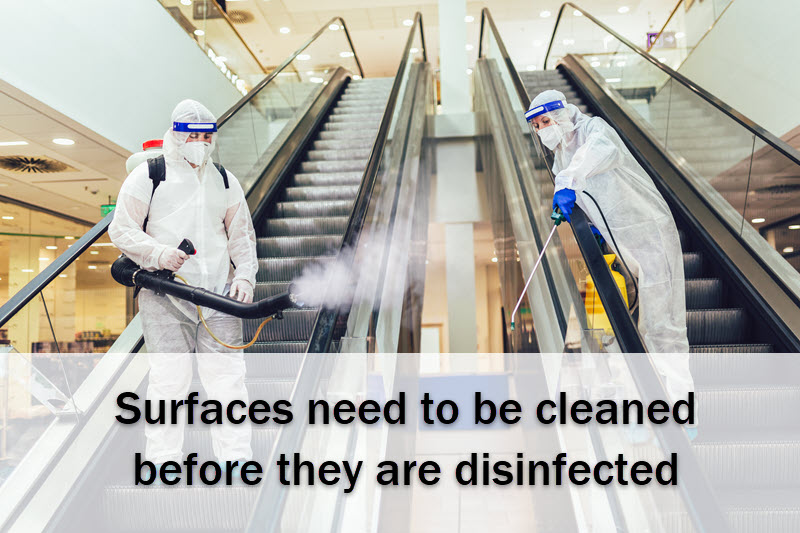
Cleaning is an essential and critical part of the disinfection process.
Cleaning is the process of removing visible debris (dirt, dust, oil, or other impurities) from surfaces. Once all visible debris is gone, cleaning has technically been achieved.
This process can reduce the number of germs that remain on a surface, but it does not kill them. Disinfectants must be properly applied to destroy whatever germs are left behind. These chemicals attach to germs and dismantle their cellular makeup. Once the cell walls have been separated, the germ “dies.”
Disinfectants are powerful chemicals, but they are only effective when used on a surface that has first been properly cleaned. Without cleaning, dirt and debris competes for the chemicals' attention and creates a barrier that prevents the disinfectant from fully adhering to the germs' cellular walls.
It's not enough to trust that a business has properly cleaned a space just because there are vacuums, brooms, or other tools on site. Cleaning must happen immediately prior to disinfection because without proper, solid, and sole contact with germs, a disinfectant won't “kill” them and they will continue to live and multiply.
This has never been more important than today. Companies looking to fight SARS-CoV2 (COVID-19) need reassurance that disinfection will work. While transmission of the coronavirus is most common via respiratory droplets, the Centers for Disease Control (CDC) says it could remain on surfaces anywhere between hours or days.
Choosing the right disinfectants and equipment
Therefore, it's important to choose a disinfectant that the EPA confirms will kill COVID-19 when used according to label directions (here's a list). There are hundreds of options. You can narrow down your search by active ingredient, use site, or contact time.
Another thing to consider is the type of equipment you want to use to distribute disinfectant. A regular spray bottle and wiping routine will normally take a lot of time for your crews to execute and leaves more room for human error. There are other options to get the job done more effectively and efficiently, including electrostatic sprayers or foggers.
Electrostatic sprayers are equipped with a special nozzle that coats each particle of disinfectant solution with a positive charge. Once the positively charged solution comes into contact with its intended target, it will adhere and engulf it entirely. For areas with a lot of nooks and crannies or hard-to-reach places, an electrostatic sprayer can be a smart option.
Foggers spray disinfecting droplets as a fog or thick mist. Not only do fogger droplets disinfect the surfaces they come into contact with, but they also disinfect particles in the air. This may appeal to your clients since the spread of the coronavirus is likely to occur as person-to-person exchanges through respiratory droplets lingering or traveling through the air.
Electrostatic sprayers and foggers can get quite expensive, depending on the type you choose, but they may be worth the investment for many BSCs. They allow your cleaning crews to cover more areas in a shorter amount of time. If you're doing a lot of disinfecting, the labor savings can quickly pay for the equipment.
If you decide to add foggers or sprayers to your toolkit, take time to properly train your crews. When used incorrectly, these equipment can leave spots and residue behind. That will typically result in a second visit to the client's facility to fix the problem—and that means a loss of revenue.
Spots and residue also indicate that the technician doesn't understand disinfectant dwell times. Without proper contact time, a disinfectant will not kill all germs and impurities. When this happens, a BSC should offer retraining with a focus on dwell times.
Given the room for error with disinfection, especially when using foggers or sprayers, the work is best left to trained professionals. Painters, window cleaners, carpet cleaners, and the like may have good intentions by offering these services, but there is plenty that can go wrong when trusting a building's health to them. Share this with potential clients to establish you as a trusted expert so you can land new business.
For new or existing clients, take time during the pandemic to explain the relationship between cleaning and disinfection. Tell them that it's not one or the other, but both. Without cleaning, disinfecting will not be efficient.
Copyright The Janitorial Store. All Rights Reserved
OSHA's Hazard Communication Standard (HCS) requires that employers provide “Right to Know” training regarding the chemicals and hazards they are exposed to in the workplace.
The Janitorial Store's Hazard Communication Training Program is a Verified Certification Program, which certifies that it complies with training best practice elements and industry standards.
Visit our Store for Certification Training Programs





