

Eight Hazards to Cover in Safety Training for Your Commercial Cleaning Business

The Occupational Safety and Health Administration (OSHA) lists employer obligations which include the following requirements:
- Provide a workplace free from recognized hazards and comply with standards, rules, and regulations issued under the OSH Act.
- Make sure employees have, use, and properly maintain safe tools and equipment.
- Establish or update operating procedures and communicate them so that employees follow safety and health requirements.
- Employers must provide safety training in a language and vocabulary workers can understand.
- Employers with hazardous chemicals in the workplace must develop and implement a written hazard communication program and train employees on the hazards they are exposed to and proper precautions (and a copy of safety data sheets must be readily available). See the OSHA page on Hazard Communication.
- OSHA encourages all employers to adopt a safety and health program.
This is just a small sampling of the more than 100 current standards containing training requirements. As the Department of Labor's OSHA cover page concludes: In short, the employer needs to ensure their employees have received training for the hazards that exist in their workplace, and the equipment, policies, and procedures used to address those hazards.
Safety Hazards in the Cleaning Industry
1. Chemicals in general cleaning products:
- Whenever possible, use non-chemical products.
- Teach your employees not to mix products, especially ammonia and bleach.
- Keep chemicals in their original labeled containers. Train employees to read the labels rather than sniffing products to identify them.
- Make sure that employees know how to correctly dilute the cleansers that they use.
- Teach employees the correct procedures to follow in case of any spills.
- Never use chemicals in areas that are not well-ventilated.
- When pouring cleaning products, do so from a low height to avoid the possibility of splashing.
- Store cleaning solutions away from the sun and away from air conditioning or heating vents.
- Store cleaning solutions together in a safe area - and not next to food.
2. Chemicals in specific cleaning jobs, such as dealing with smoke and soot damage or getting rid of mold:
- Employees cleaning up smoke or soot damage must have sufficient personal protective equipment. People with breathing issues should not clean up ash, and all vacuums should have HEPA filters or industrial vacuums with high-efficiency filters.
- If your business deals in mold removal as part of your cleaning services, familiarize your employees with the information in the EPA's publication, “Mold Remediation in Schools and Commercial Buildings.”
- PPE for mold removal includes an N-95 respirator, long gloves, and goggles.
3. Exposure to dangerous items when handling trash:
Train your employees to be aware that dangerous items may be in the trash, such as improperly disposed of needles or bloodborne pathogens.
4. Carbon monoxide poisoning:
- In 2011 a commercial cleaning worker died from carbon monoxide poisoning while cleaning a warehouse's office area's carpets with a truck-mounted gasoline-powered carpet cleaner. There was no ventilation, and his truck was running in an enclosed warehouse. This accident could have been prevented with proper training and an ironclad cleaning protocol.
- In 2012, a janitor using a propane-powered buffer died of carbon monoxide poisoning. He had not ventilated the area, and the air filter in the buffer was clogged.
- Electric-powered equipment is safer than propane-powered equipment to use indoors. All equipment should be properly maintained. Also, all employees should be trained about necessary ventilation, as well as the signs of carbon monoxide poisoning.
5. Slips, trips, and falls:
- Always mop or clean from the back of the room towards the door to eliminate walking (and possibly slipping) on wet surfaces.
- Be aware of electric cords or other tripping hazards
- Do not allow your employees to stand on the top two rungs of a ladder as they clean, and encourage having a partner to steady the ladder and “spot.”
- Many falls occur as employees clean bathrooms. One solution is to provide your cleaners with longer tools to use to scrub. Also, train your workers not to clean showers while standing in the actual bathtub.
6. Overexertion:
- Train your employees to recognize signs of overexertion. Don't risk injury by carrying heavy equipment.
- Teach your employees the safe way to lift. You may wish to invest in ergonomically safe equipment, like housekeeping carts that don't strain wrists or backs.
7. Electrical hazards:
Your employees should not operate electrical equipment while either standing in or near water. According to the Bureau of Labor Statistics, between 2011-2019, “Constructing, Repairing, Cleaning” accounted for the leading worker activities for electrical fatalities at 52%.
8. Hearing damage:
- Any time your cleaners use loud equipment, such as buffers or loud vacuums, especially for extended periods, they should use ear protection.
- Generally, any noise that is above 85 decibels can cause damage; OSHA describes that as a situation where you would have to speak loudly to someone three feet away from you for them to hear you.
Safety is crucial for your employees. Janitors and cleaners are in the occupation with the third-highest incidents of nonfatal injuries and days away from work.
- 16,480 suffering from overexertion and bodily reaction
- 12,300 affected by slips, trips, and falls
- 9,550 injured as a result of contact with objects and equipment
One safety training option for your employees is TheJanitorialStore.com Certified Training Programs including Bloodborne Pathogens, Hazard Communications, and overall General Safety training.
Copyright The Janitorial Store. All Rights Reserved
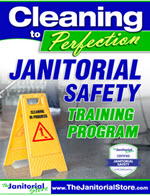
Certified Safety Training for Janitorial Employees
Janitorial safety training must be a priority in your cleaning business. Not only is it your responsibility to keep your employees safe, but paying added Worker's Compensation fees due to your own lack of training just does not make good business sense.
Buy the Training Program and learn how to use it to get Certified!




