

How the "Me Too" Movement Affects Your Cleaning Company (and what you can do about it)

Unless you've been living under a rock, you've heard about the #MeToo movement, the organized push to end sexual violence, including workplace harassment. It gained national attention in 2017 when accusations surfaced against movie exec Harvey Weinstein.
Months later, 300 prominent women in Hollywood banded together to create #TimesUp, an initiative and legal defense fund to stop sexual assault, harassment and inequality across industries.
More than a passing fad, this movement has legs. In 1998, only one-third of Americans thought sexual harassment was a serious problem. Today, that number has doubled.
Although many recent high-profile allegations have centered around the entertainment industry, no industry is immune. If anything, the noticeable lack of women in the cleaning industry makes equality issues even more pressing.
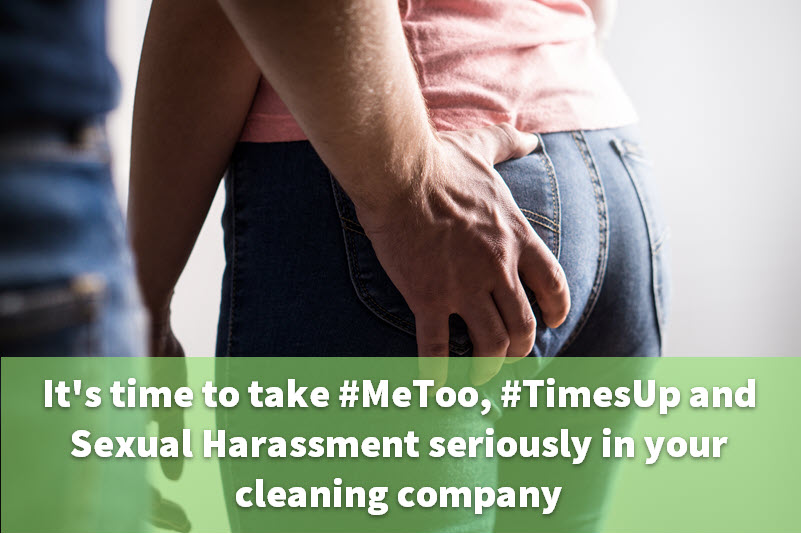
Every contract cleaning company must answer the call of the #MeToo movement or risk having change imposed upon them (and likely not in a positive way). Take a critical look at your business and ask whether you're creating a workplace culture where women are respected and treated equally.
Now is the time to dig deep and create a comprehensive and strategic plan for equality—one that includes leadership, training, and empowerment.
Lead Your Cleaning Company By Example
The Equal Employment Opportunity Commission (EEOC) has outlined the key components of harassment policies. To ensure that you're in compliance with it and any additional state-mandated guidelines, have a qualified attorney or HR professional review and revise your policies every couple of years.
You'll want to be sure your handbook includes anti-discrimination, anti-harassment, and anti-retaliation language, along with a clear complaint procedure for aggrieved employees to follow. Also, if your executive employment agreements include severance upon termination for cause, check that the definition of “cause” includes sexual harassment (explicit or implicit).
Policies are important, of course, but it's no longer enough to merely fulfill compliance requirements. Meaningful change requires top-down buy-in. Company leadership should actively communicate expectations and role-model desired values.
Employees need to see leadership take action. Start by sharing with all employees, regardless of position, that your company has a zero-tolerance policy on sexual misconduct. Even more important, encourage those in management to talk about these issues with their teams.
When the boss discusses something, it signals the issue is important and can help create a dialogue. This is particularly important with a topic that is difficult to openly discuss, like discrimination and harassment.
Remind your managers that they don't need to have all the answers. They simply need to make it clear that the company takes these issues seriously and has an open-door policy for hearing complaints or concerns.
Offer More & Better Harassment Training
Training can help create culture change, but only when done well. A successful program should cover EEOC and state guidelines, and be delivered upon employment and, ideally, semiannually to keep the information top-of-mind.
Effective training should not “one-size-fits-all” like the cheesy videos of decades past. The EEOC recommends in-person, interactive sessions led by qualified trainers like an attorney or HR professional. It also says companies should consider “bystander intervention” training, which teaches employees to recognize problematic behaviors and when and how they should take action.
Training may help employees think more carefully about their words and actions to prevent some ambiguous forms of harassment. It's unlikely to stop bad actors or completely eliminate problems. It's essential, nonetheless, because employers who do not offer such training may come under fire for that decision if faced with a lawsuit or accusation.
Video: Sexual Harassment in the Work Place
Empower Employees and Managers
Beyond prevention, training is key for educating employees on the company's grievance procedure so they are empowered to take action when necessary.
The #MeToo movement showed that many employees don't feel comfortable speaking up, either to file a grievance themselves or to report an incident they witnessed. They may believe their complaint won't be taken seriously, worry they'll be alienated by managers and co-workers, or fear retaliation.
Training for employees and managers should cover how to report harassment and discrimination, but also provide encouragement to actually do so. Also, make sure everyone knows what happens once a complaint is made. Your staff needs to know their complaints will be acted upon in a prompt and impartial manner.
If your company can't afford an independent HR reporting hotline, have a clear policy for how reporting will be handled when an employee has a problem with their supervisor. Also, provide additional training for managers on how to receive reports of harassment and discrimination. They need to know how to create a safe environment for reporting, listen and document appropriately, properly follow all procedures, and not retaliate or discriminate against a complainant.
Take Action When a Harassment Complaint Happens
Take every complaint seriously. It's all too common for managers to overlook certain behaviors because of preconceived notions about harassment. There is no “typical” abuser or victim. Harassers are often younger than expected and many times not someone in a position of authority, and same-sex harassment is just as legitimate as any other claim.
Use a standard and consistent process for conducting investigations into allegations. In serious cases, such as sexual assault, it's a good idea to hire an outside investigator for an independent assessment. Outside help can also be useful if the complaint involves executives or clients.
Take appropriate measures, whether it's corrective action or termination, and follow up with complainants after the situation is resolved. Also, keep good records of all complaints to watch for patterns of behavior that may need addressing.
Increase Diversity
A conversation about #MeToo wouldn't be complete without also addressing the need to get more women (and minorities) onto the payroll and into leadership roles at cleaning companies. Fewer women in the workplace doesn't avoid #MeToo issues—it only amplifies them.
Examine your employment data for disparities and establish a process to address gender parity in hiring, pay, and leadership. On the last count, here are three ways to get and keep more diverse leaders:
1. Don't go by instinct
We often hire people similar to ourselves, which is problematic if your management team is mostly white men. Instead of making hiring decisions based on gut or who you like, rely on best practices for interviewing along with well-designed assessments.
2. Look at potential
Performance metrics can be contaminated by company culture and are very often not the best measure of a person's ability. Instead of relying heavily on what a candidate has done in the past, give more weight to their potential.
3. Consider soft skills
Confidence and competence are often conflated during interviews, which may give the edge to men. Instead, look for candidates who can set aside selfish interests and inspire others through appreciation, respect, and empathy.
Finally, a Pew Research survey of 8,000 workers found that 55% of men and 47% of women think it's more difficult for men to navigate workplace interactions in the wake of the #MeToo movement. Another survey by LeanIn.Org found almost 30% of male managers are uncomfortable working alone with a woman—more than twice as many as before.
Substituting discrimination (intentional or not) for harassment is not the solution to managing in the #MeToo era. Make sure your male managers understand this distinction and are being intentional about mentoring women and including them in meetings and social events.
It has likely taken your cleaning company years to earn it's good reputation. It can take only minutes for an improperly handled #MeToo allegation to destroy it. Don't wait for problems to arise before instituting change. Get serious about harassment, discrimination, and equality now.

Do You Need Help with Growing and Running Your Cleaning Business?
The Janitorial Store is a private, members-only resource for those serious about starting, improving and growing a profitable cleaning business.
As 32 year veterans of the cleaning industry, we know that the business of cleaning can be incredibly challenging. The competition is fierce and the margins are low. It's a demanding business and it's tough to grow it and make it successful. Within the private members-only area, you'll find a huge selection of in-depth information that you won't find anywhere else on the Internet.
You can struggle or succeed. The decision is obvious... Join Today!
Visit our Store for Certification Training Programs





