

Low Maintenance Cleaning Equipment: Calculating TCO (Total Cost of Ownership)

When buying pricey equipment, many cleaning business owners focus on sticker price. Or, they calculate labor savings from increased productivity and use that number to justify their purchase. What too many overlook, however, is how much maintenance a machine will require over its lifetime.
Burnishers, extractors, sweepers, scrubbers, and even certain vacuums can last five to 10 or more years. That's a lot of time for maintenance expenses to add up. And those costs can dramatically increase a machine's total cost of ownership (TCO).
There are several factors that influence TCO (Total Cost of Ownership), including:
- Initial Expense: The price tag on the machine, plus accessories, taxes, shipping costs, and warranties.
- Training: The amount of money and/or lost time needed to get employees up to speed on the new machinery.
- Maintenance: The cost of replacement parts for routine maintenance, plus the time required to keep the machine in good working order.
- Repairs: These are the unscheduled costs associated with servicing broken equipment (including things like shipping, rental costs, or added labor costs if the work must be done manually).
- Productivity: The above considerations add to TCO, but labor savings realized from a more effective, efficient machine can actually lower TCO.
Considering only one or two of these factors fails to paint the whole picture. Doing so can leave a cleaning business owner wondering why a new machine (or a fleet of them) didn't affect the bottom line as expected.
This article will focus on why maintenance is a key component of TCO, and how to properly include it in your equipment purchase process.
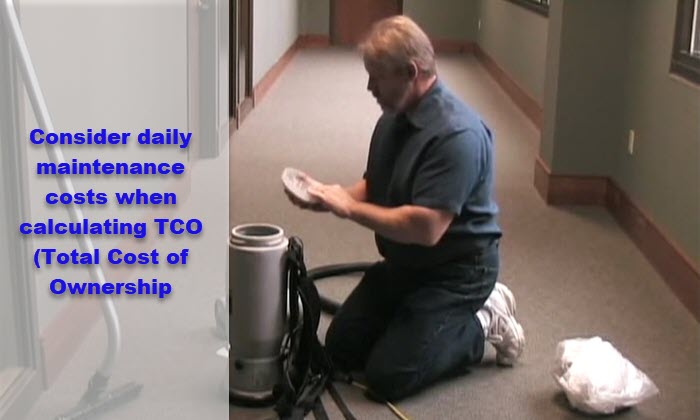
Maintaining Equipment – Looking at the Whole Picture
Calculating productivity gains is simple. Example: You clean 30,000 square feet of floor each week. It takes 6 hours using a wet mop. An automatic scrubber can do it in 1 hour, saving 5 hours of labor. If your labor costs are $20/hour, that's $100 a week or more than $5,000 a year. If the machine costs $15,000, then you make your money back after 3 years.
This is how many cleaning companies evaluate new machinery, but their math is incomplete. It's also important to consider how much it will cost to maintain that scrubber over its lifetime.
To extend the life of any machine, your staff will need to perform daily maintenance tasks. After every 100 hours of operation, there will also be more involved maintenance required.
Ask your supplier to outline the routine maintenance requirements for every machine you're considering.
- How often will you need to replace parts due to normal wear and tear?
- How much do these items cost?
- Can you fix these in-house or do you need to send the equipment out?
- How much downtime is required?
- How do these variables change from machine to machine?
Also, get clear about a machine's expected life span. What other parts are likely to need replacement over that time, and what are those costs?
As an example, vacuums will routinely need replacement brushes, pads, pad drivers, wheels, rubber skirts, dust control devices, filters, casters and hoses. Over a 7 to 10 year lifespan, however, it may also eventually need new brush motors, drive motors, control boards, batteries, electrical cords, hose connectors, switches, solenoids, regulators, and more.
Finally, ask about common repair issues. You may want to seek input from peers or look at online reviews to get unbiased information. Learn what is and isn't covered in any warranty offered by the manufacturer.
As an example, many machines come with three-year warranties that cover repairs (not routine maintenance). Often, these warranties cover the costs of parts during that period, but may only cover labor costs for the first year.
Understanding coverage specifics will help you properly assess your potential costs. You may have labor costs for in-house repairs, or contractor costs for outsourced repairs.
With all of this information in hand, you'll be a more savvy shopper. Calculate purchase price, maintenance costs, and labor savings for each product so you compare apples to apples. You may be surprised to find that a more expensive machine will actually cost far less over its lifetime than a discount product.
Note: If you're buying equipment exclusively for a single client and expect to only need that machine for that contract period, price may actually be the most important factor. Also, rental equipment may be worth considering in these cases.
Maintaining Innovative Equipment
Want to lower TCO and improve the ROI of your equipment investment? Many manufacturers are exploring new technologies that reduce maintenance requirements.
Look for equipment that can be assembled or maintained without tools. For example, there are upright vacuums with easily accessible ports that make quick work of removing clogs and quick-access doors that simplify the process of removing and replacing bags, brush rolls and filters. Making quicker work of these tasks may save only a few minutes here and there, but that time adds up over the course of a machine's life. Also consider equipment that can work with your existing accessories to reduce the parts you must purchase.
Also, ask your supplier about new innovations that may reduce your TCO. There are new vacuums with pigtail cords that prevent machine-connected cord fraying and easily replaceable and washable HEPA filters. There are also machines that automatically maintain the necessary water levels in batteries to reduce the frequency of replacement.
Don't Skimp on Maintenance
To fully maximize your investment in machinery, routine maintenance is an absolute must. While vacuums and floor machines are more dependable and durable than ever, they still have moving parts and get a lot of use—and that inevitably causes problems.
Taking care of your machines daily will extend the amount of time between repair shop visits. In fact, manufacturers say doing all planned maintenance can add about two years onto the life of most floor machines. That's money in the bank.
Every machine is different and has its own unique maintenance requirements. To learn what the manufacturer recommends, take time to read the owner's manual (very often, those books are trashed or thrown in a folder without ever being viewed). When bigger problems arise, the troubleshooting guide can help explain how to fix it (how to handle repairs in-house and when to seek help from a service professional).
It's important to communicate to your staff why maintenance matters, plus share your expectations for their role in taking care of the machines. Make this a clear part of your employee training and daily tasks lists.
For any cleaning operation, equipment is an important part of improving productivity and boosting the bottom line. Before rushing to purchase a pricey floor-care machine, however, you should understand TCO and the role maintenance plays in the short- and long-term costs of any machine. Only with this 360-view can you make truly smart purchases that truly deliver.
Copyright The Janitorial Store. All Rights Reserved

Do You Need Help with Growing and Running Your Cleaning Business?
The Janitorial Store is a private, members-only resource for those serious about starting, improving and growing a profitable cleaning business.
As 30 year veterans of the cleaning industry, we know that the business of cleaning can be incredibly challenging. The competition is fierce and the margins are low. It's a demanding business and it's tough to grow it and make it successful. Within the private members-only area, you'll find a huge selection of in-depth information that you won't find anywhere else on the Internet.
You can struggle or succeed. The decision is obvious... Join Today!
Visit our Store for Certification Training Programs





