

Why You Need HIPOs on Your Management Team
A commercial cleaning company is only as strong as its leadership team. It's not enough to create a great team and then forget it. Your owners, supervisors, and managers will age, so you must constantly consider who may become your future leaders. And those future leaders should include HIPOs (high potentials).
First you need to understand what makes a good leader. Too often, cleaning companies promote their highest performing employees to leadership roles as a reward for being reliable technicians. In truth, the key is to identify your highest potential employees and groom them for promotion.
Your Best Cleaners Aren't Always the Best Supervisors
It's important that your best cleaners feel valued and appreciated, but promoting them to a supervisory role may not be the best way to retain those staff members. The skills needed to be a great leader and a great cleaning technician don't always overlap.
In fact, high-performing technicians promoted to supervisory roles often have difficulty adjusting to the change. They may struggle to manage employees who were once their peers; effectively communicating and resolving conflicts are common problems. That's why promoting HIPO's makes more sense.
Research has found a strong correlation between good bosses and employee engagement, customer satisfaction, and revenue.
Promoting the wrong person into management can be a costly mistake. There's the money spent on training the person, lost productivity during their training process, and additional money required to find and train their replacement. Not to mention the potential hit to employee morale; half of employees have quit a job to “get away” from a boss, according to Gallup's 2015 State of the American Manager report.
Conversely, promoting the best potential managers into leadership roles could help boost employee performance by up to 30%, says a recent study from the National Bureau of Economic Research.
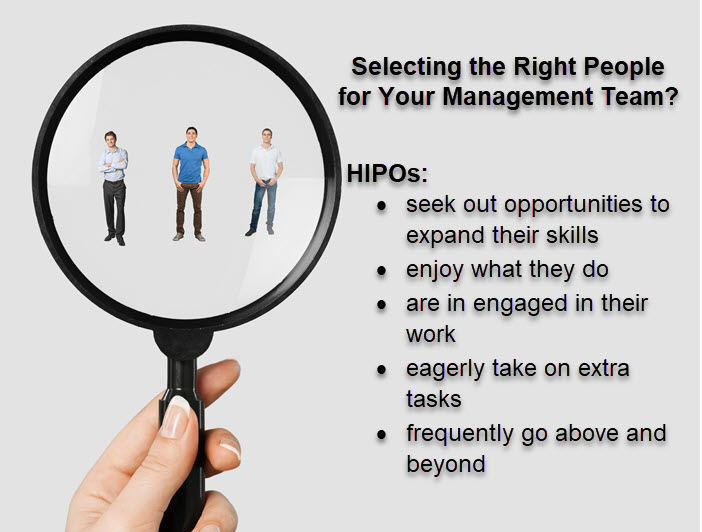
When it comes to employee advancement, it's important to take a holistic view instead of focusing on performance indicators, like cleaning efficiency or effectiveness. Keep an eye out for high-potential employees—the ones who:
- seek out opportunities to expand their skills
- enjoy what they do
- are in engaged in their work
- eagerly take on extra tasks
- frequently go above and beyond
These high-potential employees – HIPO's – are ideal candidates for supervisory roles, even if they aren't necessarily your star cleaners.
Many business owners pass over these high-potential employees (HIPOs) at promotion time, assuming their ambition will soon lead them to a bigger company with deeper pockets. Fortunately, you can retain high-potential staff members with a supportive work environment that allows them to move up the ranks and continue to challenge themselves.
Grooming your high-potential employees is the most effective decision you can make to keep your company growing and your leadership transitions smooth, according to Training Magazine's Annual Leadership Development Survey. To be most useful, however, this process should be part of a formal succession plan.
Having a succession plan in place can help circumvent the three biggest barriers to leadership development:
- access to training and development resources
- understanding how to best train in leaders with varying expectations for learning
- lack of executive support for emerging leaders.
A succession plan only works, of course, if it's paired with a strong leadership development program. Once you've identified your high-potential employees, you must help them develop the necessary skills to someday step into a leadership role.
Companies that invest leadership development (even when they don't have open management positions) can fill supervisory roles more quickly than companies that don't. According to the Training Magazine survey, only 58% of companies that put a low emphasis on leadership development can bring a new leader to high proficiency in less than 18 months, but it jumps to 75% among companies that make leadership development a high priority.
What's more, companies without solid leadership-development plans run the risk of creating a toxic business culture. Employees who don't see a path for advancement or potential to learn and grow, will quickly become unhappy and jump ship. Before long, your company will develop a negative reputation in your service area, making it hard to find quality employees and (potentially) causing customers to choose other service providers.
To develop HIPOs, encourage managers to begin delegating some tasks to them. This will require some hand holding, but it gives the employees a chance to show how they might handle a leadership role.
Once employees move into the management ranks, ease the transition by helping them identify and manage priorities, develop relationships with peers and subordinates, and deepen their leadership skills. Having an existing manager mentor them for some time can be incredibly valuable.
Working on leadership development and succession planning will likely bring to light the generational differences between your staff members. Many leadership teams are mostly Baby Boomers and Gen Xers, but Millennials will become an increasingly important part of every cleaning company's future. The various generations have very different workplace expectations and management styles:
- Baby Boomers have strong work ethics and value professional accomplishments. They are generally most motivated by things like promotions, bonuses, and respect.
- Gen Xers are entrepreneurial and creative; they place a lot of value on individuality. They are most interested in rewards that allow for greater work-life balance, like flex schedules and extra time off.
- Millennials are highly motivated to find meaningful careers that allow them to constantly develop their skills and grow personally. They tend to values opportunities to learn and for advancement more than an increase in income.
Understanding these issues is key to creating a company that can age with its team. Keep them in mind as your leadership team expands to include more managerial roles, and as current leaders retire and their openings filled by new members.
Each of your employees has different strengths and weaknesses. As the ultimate decision maker for your company, it's critical that you understand the difference between those who are high performing and those with high potential. Focusing on the latter, and grooming them now to become part of your company's succession plan, is the key to long-term, sustainable success.

This is a comprehensive series of 7 videos for training janitorial supervisors. There is over 2.5 hours of content here and they will never remember it all if you try to do it all at once. Break it up and do a little each week over time, or schedule it out over a couple months.
Visit our Store for Certification Training Programs





