

Implementing a Comprehensive Process for Recruiting, Hiring, Orientation, and Onboarding Cleaning Employees

Let's face it, you cannot run a successful cleaning business all by yourself if you plan on expanding and taking your cleaning business to the next level. You need dedicated people around to help your business grow. This process will include recruiting, hiring, orientating, and onboarding people for your commercial cleaning company.

Recruiting involves creating a strategy for finding employees that will be a good fit for your cleaning business needs, whereas hiring is a process through which a vacant position in the company is filled with new talent. Employee orientation is the process of completing the necessary new hire paperwork, payroll, and covering company policies and job expectations. Onboarding is the entire series of events, including the orientation protocols, in order to familiarize the new hire to the company and their new job position.
Recruiting and Hiring New Cleaning Employees
When it comes to recruiting and hiring, consideration should include the following:
- Determining your needs
- Reviewing or creating job descriptions
- Determining pay rates and type
- Developing your recruiting strategy (including writing an irresistible employment ad campaign)
- Conducting interviews
- Selecting a candidate
- Making the offer
- Orientation/Onboarding
Hiring new employees includes a variety of paperwork that will need to be completed. Having a checklist for this process will definitely help so you do not forget anything. Prepared paperwork may include W-4, I-9, employment history, background check release, company policy manual, benefits paperwork, etc. You will be responsible for providing the W-4 form to the new employee. Check with your state to determine your needs in regards to the using the federal form or a W-4 that is state-specific.
You can find and download W-4 forms by visiting the IRS website. They are available in both English and Spanish.
W-4 IRS Form
W-4 IRS Form Spanish
About W-4 IRS Forms IRS website
New hires should feel welcomed the first time they step through the door since this is where first impressions are created and attitudes about the company are formed. Having a systematic process is a must-do if you want to engage new hires and help them transition smoothly into their position.
Your company system should be a comprehensive and detailed, yet simple to follow. Make sure you have a specific outline with checklists and deadlines in place, so you can track and measure each new hire's progress. It is a good idea to do onboarding in small groups; if possible, because having multiple new hires start at the same time creates an opportunity for relationship building. In addition, it'll make it easier to have set start dates … for example, the first Monday of each month. This is a prime example of working smarter, not harder.
Onboarding Opportunities and Process
The onboarding process should also be laid out in a way that it creates opportunities for new hires to work with their co-workers. You can get existing employees involved by having new hire shadow an experienced team member for a few weeks at one of your customer's locations. You can also assign mentors or “buddies” for each new hire so they have a designated person to turn to when they have any questions or concerns throughout the onboarding process. It's all about collaborative learning!
Unfortunately, the orientation process can sometimes become rushed, disorganized and neglected resulting in confused and disappointed employees. Don't expect to just hand the new employee a company handbook, instruct them to read it, and you're done. This can lead to future misunderstanding, disputes and grievances with employees.
The orientation process is not only where the new employee is welcomed, introduced to the company, and made to feel comfortable with their new job and surroundings, but where relevant company information is discussed in regards to its policies and procedures.
New employees will be absorbing a lot of information during orientation. A thorough and well thought out orientation session will make the transition easy as possible. It will be imperative that the discussion topics cover all company policy and procedures and are clearly outlined for the new hire from the start.
Begin the orientation by filling out the necessary paperwork, including the W-4, I-9 and other required employee information for your records. Next, provide the new hire with a copy of your cleaning company policy manual and employee handbook to follow along during the discussion and for future referencing.
10 Discussion Topics During the Employee Orientation Process
This list is not all-inclusive, but it brings up many items that cleaning companies neglect to discuss.
- Introduction to the Company. Explain the company's primary goals and future goals, the company history, code of conduct and the mission statement as well as an overview of what the handbook is about.
- Nature of the Employment Relationship. Discuss such topics as the orientation period, employment law/regulations, and pertinent employment information such as company information confidentiality, conflicts of interest, grievances, possession of keys, dress code, equipment policy and the use of company owned vehicles.
- Job Description and Pay Scale. Define the position's duties, set requirements for filling the position, and what the pay scale is for their position.
- Employee Conduct. Go over what is expected of them while on the job and at the customers facility. This would include customer service, visitors, building security, smoking, company and personal property, cell phone use, texting, etc.
- Wage and Hour Policies. Go over the importance of following their work schedule and being on time. Include contact information for supervisors and managers, time keeping procedures, overtime, holidays, lunch periods/breaks, and their pay periods and payment methods as well as payment options such as direct deposit.
- Attendance and Absenteeism. This topic will include absenteeism and tardiness, sick leave and medical leave, and leave of absence. If they must fill out a day's off request form to receive time off, give them the necessary form.
- Employee Benefits. If you provide any benefits, make sure to discuss them thoroughly with the employee. This would include the company's vacation policy and pay, requests for vacation days including a copy of the company form, PTO (paid time off), any retirement offerings, and bereavement and jury duty leave.
- Quality Assurance Guidelines. It's important for the new hire to completely understand what type of quality assurance and guidelines they need to follow to be a successful part of the team. Also, go over building, vehicle, and equipment inspections, performance evaluations, salary merit increases, and performance appraisals.
- Corrective Counseling and Terminations. It is essential that the new hire clearly understand the ramifications from performance problems and company violations, resolving said problems through counseling, and the steps of disciplinary actions as well as resignation/termination policies.
- Safety. In addition to the extra janitorial safety training they will be receiving during procedures training, you want to instill the importance of workplace safety during orientation. Topics of discussion would include injuries and illnesses, accident reporting, alcohol/drug use and testing.
Acknowledgement of the cleaning company policy manual and employee handbook is the final step. The purpose of a signed acknowledgment is to demonstrate that the new hire not only received the policy manual but is responsible for understanding the information contained within the policy manual. You want to protect yourself and your company from any lawsuits or litigation brought on by disgruntled employees or employees who felt they were wrongly terminated. A signature is not required by law, but highly recommended at orientation and anytime addendums or updates are added to the policy manual. This can be accomplished by making sure the new hire and the owner/manager sign off and date the acknowledgement page of the policy manual.
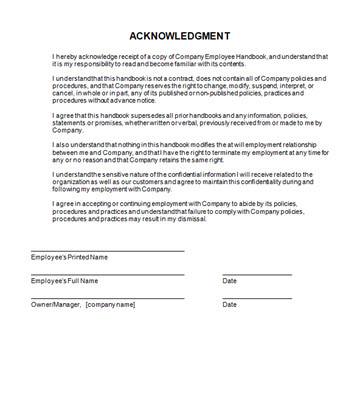
You've just thrown a lot of information at your new employee. Only after this initial orientation should you begin cleaning procedures training and detailed safety training. Many companies either take a break at this time or begin the procedures training on the second day, giving the employee plenty of time to ask questions and absorb the information.
Cleaning company policy manuals and employee handbooks are an important part of the orientation process as well as business administration. It communicates the expectations between the employer and employee and will be used as a reference guide for the employee to follow in order to maintain their employment status. Make sure to review your manual and handbook periodically so that it is up-to-date and compliant both legally and internally. This will help to avoid problems down the road.
Check in with the new hire a lot. We already talked about the importance of having milestones, 30-60-90 day questions, evaluations, etc. throughout the onboarding process. Aside from allowing you to assess the employee's development, these benchmarks also serve as a great point for you to reach out. Ask them how everything is going. What successes have they experienced so far? What challenges have they faced? What feedback do they have about the onboarding experience, the company, co-workers, working environment? Engaging with new hires at regular intervals throughout the entire onboarding process will help them feel connected. In addition, it'll provide your company with crucial feedback on the effectiveness of the onboarding process. You can use that information to improve the experience for future new hires. It's just a matter of applying the right protocols and processes to get new hires up to speed while integrating them into your company's culture.
“You're only as good as the people you have around you.” John C. Maxwell
Copyright The Janitorial Store. All Rights Reserved

Download the Roadmap to Hiring Success
It is time to fine-tune your hiring process? Your hiring process includes getting the "Legal Stuff" set up correctly, writing job descriptions, setting up your pay scale, writing your ads, recruiting candidates, interviewing and asking the right questions, onboarding and training
Make it easy on yourself and use the roadmap to plan you hiring process today!
Visit our Store for Certification Training Programs





