

The Ins and Outs of Financing Janitorial Equipment

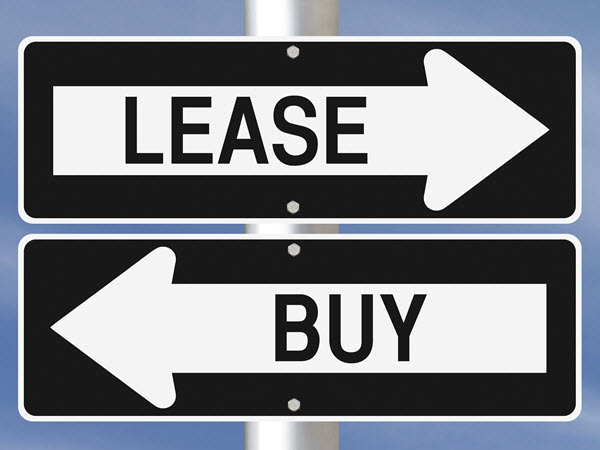
Need new equipment, but can't afford the hefty price tag of something like a $20,000 autoscrubber? When it's time to add big-ticket items to your fleet, there are two primary options for financing janitorial equipment—buy or lease.
The Small Business Administration says more than 80 percent of U.S. businesses lease equipment, but it's not yet a common practice in the cleaning industry. When it comes to deciding whether to lease or buy, many building service contractors (BSCs) feel overwhelmed and under-informed.
The Benefits of Buying Janitorial Equipment
If you can afford it, purchasing equipment in cash is almost always the smartest business move. In the case of very expensive machines, however, this isn't always plausible. In those cases, you may be forced to decide between a bank loan and a lease.
The upside of borrowing money:
- The interest rates are typically lower than on a lease.
- You could sell the machine during the loan period (then pay off the note and keep any surplus income) if your business needs or situation changes.
- You'll own the machine at the end of the loan period, which means you can sell it to recoup at least some of your investment.
- It is considered an owned asset, which provides a tax benefit in the form of depreciation.
The downside:
- Banks often want a down payment for a big purchase, which requires immediate access to cash.
- Despite a lower interest rate, the monthly payments are typically higher on a loan than a lease.
- Some banks have variable (not fixed) rates for these types of loans, so your payments could fluctuate over the life of the loan.
- A loan affects a BSC's credit and borrowing capacity.
- You are fully responsible for all maintenance and repairs on the equipment.
- The machine goes on your balance sheet as a purchase, which reduces working capital.
The Lowdown on Leasing Janitorial Equipment
A lease is an agreement that allows a BSC to make payments to a vendor (typically a janitorial distributor) to borrow a machine for a certain amount of time. It's straightforward, but there are distinct pros and cons to leasing equipment.
The pros of leasing:
- A lease usually requires little or no down payment.
- The monthly payments are lower than they'd be on a loan to buy the same equipment.
- Leases usually have fixed (not variable) rates for the entire lease period so your monthly payments will never change.
- Payments for a lease show up on a BSC's balance sheet as an expense, not a purchase, which preserves working capital.
- A lease doesn't affect a BSC's credit, which protects your borrowing capacity in case of an emergency or other need.
- A portion of the fees on a lease are tax deductible as an operating expense.
The cons:
- Higher interest rates means a lease is more expensive than a loan.
- If you end up buying the machine when the lease ends, the total cost will be significantly higher just purchasing it from the start.
- You must keep the equipment for the entire lease period, regardless of changes in your business.
- Usually, the BSC is responsible for all or some maintenance costs during the lease.
- You can never sell the equipment to recoup some of the cost.
- There are no tax benefits for depreciating an owned asset.
Why Lease Janitorial Equipment?
Leasing is almost always more expensive in the long run than purchasing. So why do it? It's often the best option for smaller companies that need to reduce their upfront capital expenses.
The primary reason BSCs lease is to gain access to pricey machines they otherwise couldn't afford. As an example, a very small BSC hoping to expand may need to add several ride-on machines to his fleet. A lease allows him to get $15,000 worth of machines without depleting his savings or eating up all of his available credit.
Another time leasing may make sense is with equipment that's frequently updated. Rather than pay full price for a machine that will be obsolete in two years, a lease allows a BSC to have up-to-date equipment for a fixed amount of money he can work into his budget each month.
Finally, leasing can allow BSCs to spend more heavily on business-building efforts. Money that would otherwise have been spent to buy a machine or serve as a down payment can instead invest in marketing efforts that deliver big ROI in terms of new clients.
Leasing is typically best reserved for the most expensive machines. It's probably not financially savvy to sign a multiyear lease on a $400 vacuum, but a $10,000 autoscrubber is another story. If dollars are tight and the need is urgent, a lease may be the best (and only) way to get access to that pricey machine.
Lease Ins and Outs
Leases on janitorial equipment are much like those used for cars. The BSC makes regular payments to “borrow” the machine from a vendor for a contracted amount of time. At the end of the lease period, the equipment is returned to the vendor; the end user has no further financial obligation, but also loses any value left in the equipment.
It's important to understand the type of lease you're considering before you sign. In fact, the leasing industry isn't regulated, so it's wise to have an accountant and attorney review the contract. Don't let hidden fees catch you unprepared.
The type of leasing program you choose depends on your needs as well as what your supplier offers. Most leases in the janitorial industry run two to five years. Two of the most common options you'll encounter are capital and fixed-purchase leases.
- Capital Lease: In this arrangement, the BSC agrees to the amount and length of lease payments, and then buys the machine at the end of the term (usually for $1). Sometimes the purchase is optional.
- Fixed-Purchase Lease: In this program, the BSC agrees to lease payment terms with an option to buy the machine at the end for a predetermined price (usually 10 percent of the original price) or return it to the vendor.
Be sure to choose a closed-end lease with no balloon payment due at the end (unless there's a predetermined buyout price). An open-end lease may leave the BSC responsible for paying the difference between the machine's current value and the value established in the contract.
You'll also want to ask the vendor whether the leased equipment includes a warranty or maintenance. The BSC may be required to purchase a service agreement (this is usually rolled into the lease payments) to cover items not included in a warranty.
Deciding whether to lease or buy requires a little math. Calculate the estimated annual cost of each option. For purchasing, add the price tag and average lifetime maintenance costs, then divide by the expected lifespan of the machine. For leasing, add up a year's worth of monthly payments (plus any maintenance contracts and down payments, divided by the total length of the lease). Although this isn't the whole picture, it's a good overview of the difference.
Copyright The Janitorial Store. All Rights Reserved
Visit our Store for Certification Training Programs





