

Hazard Communication Program and Chemical Safety for Cleaning Companies

If you own a cleaning company, you are well aware of all the different types of cleaning chemicals your company uses to clean and maintain your customers' facilities on a daily basis. Your supervisors, cleaning technicians, or any employee who uses or may come in contact with these chemicals needs to be aware of the dangers involved. They have the right to a safe work environment and the law requires it. That is why you should have a Hazard Communication Program in place. Your employees need to know how to handle cleaning chemicals safely, even if they're certified as "green".
Cleaning companies need to have a hazard communication program that includes chemical safety
"No one should have to sacrifice their life for their livelihood, because a nation built on the dignity of work must provide safe working conditions for its people." Secretary of Labor Thomas E. Perez
Unfortunately, about 15 percent of workplace injuries and fatalities are related to chemicals, according to the latest information from OSHA. The OSHA Hazard Communication Standard (HCS) states, “In order to ensure chemical safety in the workplace, information about the identities and hazards of the chemicals must be available and understandable to workers.”
Your Hazard Communication Program
Every company that uses hazardous chemicals is required to have a Hazard Communication Program in place. This Hazard Communication Program template (available to The Janitorial Store members) will provide your company with a strong hazardous chemical program that complies with the OSHA Hazard Communication Standard; title 29 Code of the federal Regulations 1910.1200
The purpose of the Hazard Communication Program is to inform employers and employees about the hazardous substances in the workplace, potential harmful effects of these substances and appropriate control measures. It will ensure that the hazards of all chemicals used by your company are evaluated and that information concerning the potential hazards is transmitted to employers and employees. This Hazardous Communication Program template includes record keeping information for your company regarding employee information and training, container labeling, and safety data sheets (SDS), hazardous non-routine tasks and hazardous substances inventory list.
Hazard Communication Pictograms
The Hazard Communication Standard (HCS) requires HCS Pictograms on labels to alert users of the chemical hazards to which they may be exposed. Each pictogram consists of a symbol on a white background framed within a red border and represents a distinct hazard(s). The pictogram on the label is determined by the chemical hazard classification.
Employers must train their employees on what the pictograms are and what they mean. Here are four of the nine pictograms used on labels to alert users of the chemical hazards to which they may be exposed.
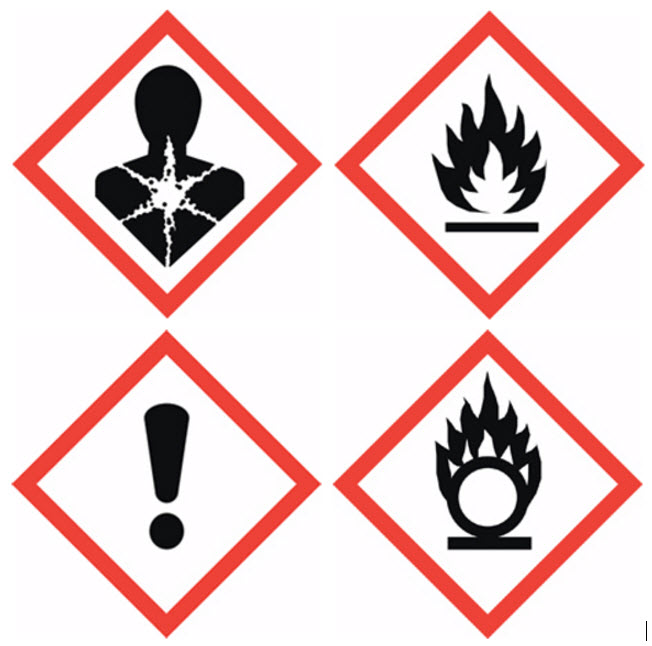
TJS members can use this HCS Pictogram document to show your employees the pictograms and hazards associated with them.
Additional tips to include with your Hazardous Communication Program:
- All cleaning chemicals used in a building must have an SDS sheet. SDS (Safety Data Sheets) need to be available where the chemicals are being used and stored, including the janitors closet and vehicles if needed.
- All containers must have a label. Hand-made labels DO NOT qualify as an appropriate label. Each label must have the name of the product, required hazard warnings, and the name, address and phone number of the manufacturer. If the labels are worn or unreadable they should be replaced. Check with your janitorial distributor, as they should be able to provide extra labels.
- Regardless if the chemical container does or doesn't have a label, don't sniff it to see if you can identify what's inside - a small sniff of a hazardous chemical can be dangerous and deadly.
- Never smoke around cleaning chemicals.
- Never mix chemicals together – even if they are the same kind of chemical, due to shelf life, and especially ammonia and bleach; this is a lethal combination.
- If diluting chemicals with water, do it over a sink and not over an area that can be easily stained like carpet or a porous hard floor surface.
- Always wear PPE (personal protective equipment) like gloves, safety glasses, and possibly respirators when pouring or diluting chemicals.
- Chemicals require proper storage. Never store chemicals near electrical equipment, heat or in direct sunlight. Find a well ventilated area for storage.
- Check the SDS sheets for instructions on proper disposal of chemicals. Do not just pour them down the drain or flush them down the toilet without checking the SDS first.
After you have your written program in place, plan a training meeting with your employees to review the entire Hazard Communication Program. After covering the policies, answer any questions they may have and then have them sign a form stating they received the training and understand the program's procedures and requirements.
Copyright The Janitorial Store. All Rights Reserved
OSHA's Hazard Communication Standard (HCS) requires that employers provide “Right to Know” training regarding the chemicals and hazards they are exposed to in the workplace.
The Janitorial Store's Hazard Communication Training Program is a Verified Certification Program, which certifies that it complies with training best practice elements and industry standards.
Get Your Copy Today, and then purchase the corresponding exam for each of your employees in order to become Certified!
Visit our Store for Certification Training Programs





