

Are Your Prospects Making Assumptions About Commercial Cleaning Services?

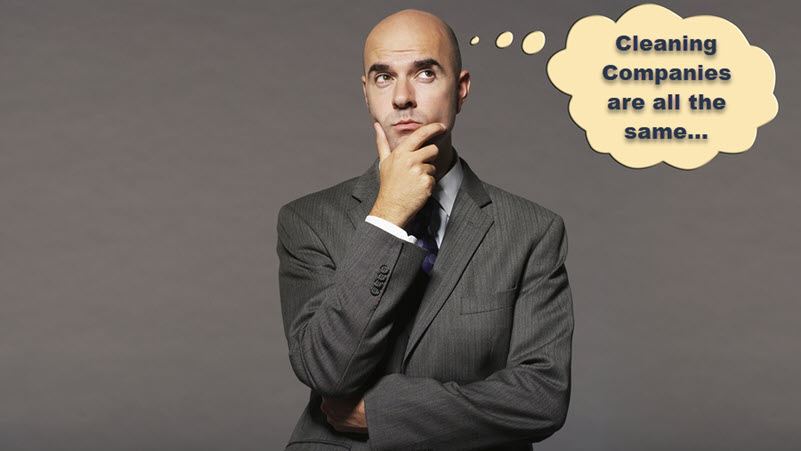
There are many misconceptions and incorrect assumptions about commercial cleaning services. Many of these assumptions are widely believed by building owners and facility managers alike. What it all boils down to is that quite a few decision makers believe that all cleaning companies are created equal. Since these are the people that will ultimately decide who they will choose to clean their building, it will be up to you to set them straight about your company and improve your chances of converting that prospect to a customer.
Here is a list of the top 5 commonly held assumptions about commercial cleaning services:
Assumption 1: Commercial Cleaning Service providers are all the same.
All commercial cleaning companies are the same so you might as well hire the company with the lowest quoted price, right? Many prospects have had bad experiences with poorly managed commercial cleaning companies. Because of these bad experiences, they assume all cleaning companies are the same and go with the lowest price provider every time. This is another incorrect assumption - all commercial cleaning service providers are NOT all the same.
Yes, price must be a consideration, but it should never be the only consideration when choosing a cleaning service. A cheap price might indicate an inexperienced company that doesn't understand just how much time it is going to take to clean the building. This company will soon realize they can't operate, much less make a profit, at the low price they quoted, and soon will be asking to raise the price, or cut back on the services currently being provided. Or, they'll just start cutting back without having a discussion with the client, leaving that client frustrated with the quality of service.
Companies that offer cheap prices in order to secure an account usually end up performing subpar quality cleaning and find they are unable to fulfill the contractual requirements. The prospect begins to notice that their building is no longer being cleaned like it should and realize that perhaps choosing the company with the lowest price may not have been the best decision. When it comes to price, offer a reasonable price for solid, consistent cleaning, be responsive, and help your prospects meet their budget as well as their needs.
Assumption 2: The higher the price the better the service.
Is it a myth or reality? People often say you get what you pay for and in most cases that's true. The quality of service being provided will generally reflect back on the price the customer is paying for that service. But there are a lot of inexperienced cleaning business owners out there who price their services too high. They just don't have a good understanding or the necessary experience to accurately price their services.
Other companies may price on the high side to provide themselves wiggle room for negotiating. Residential cleaning business owners branching out into commercial cleaning oftentimes price their service too high because they're pricing based on the low production rates typical of residential cleaning and the higher hourly rates they're familiar with. These companies usually end up pricing themselves right out of contention for that building.
As a building service contractor, if you calculate every job using the same pricing method, you are undervaluing your services. The price of the job at hand should be determined, at least in part, by the type of business, number of staff at the building, customer traffic, soil conditions, the customer's expectations and their cleaning needs. The first question asked by prospects inquiring about cleaning services is usually “How much does it cost?” What they really want to know is what is it worth, or what is the value? How you calculate and present your price often has a great deal to do with how the prospect perceives the value of your service.
Assumption 3: Bigger is always better.
Not always. Certainly, if it's a huge account with several hundred thousand square feet, the prospect may require a larger sized company that can handle the duties. But some prospects will assume they must choose a larger company because the larger company will have the resources necessary to handle their cleaning needs. But big companies can actually be less responsive and provide less personalized service. Large corporate companies have to abide by corporate rules and regulations, which often hinder their ability to negotiate on prices, personalize services and perform last minute requests.
Local companies can be a good choice because they're putting more money back into the local economy. They hire local and buy local. They also tend to work harder for their local clients because they have roots in the area and it's their reputation on the line. Many times, it's the smaller independent companies that provide better prices and better service. It's important to point out to the prospect that you are a locally owned and operated company; it can sometimes make a big difference and impact their hiring decision in a positive way.
Do prospects really care if you are a franchise or independent? Prospects are well aware of the franchise brands out there and they can sometimes be steadfast in their thinking that a franchised cleaning business is better than an independent since the franchise is a noticeable brand name and is already a successful business model. There are benefits to a franchise but also drawbacks. When buying into a franchise, you are buying a successful brand name, marketing strategies, and operational efficiencies. But you are going to pay for these services. You will have to pay an initial franchise investment as well as royalty fees of your monthly gross sales. You will also be under contract and be bound by the franchise agreement when it comes to certain business decisions. A cleaning company is only as good as the people who are running it whether under the franchise or independent flag and prospects should be made aware of this when deciding on a cleaning company.
Assumption 4: If it looks clean it must be clean.
Many prospects don't have a clue on what it takes to perform commercial cleaning tasks. How many of your prospects do you think know the difference between a disinfectant and a sanitizer? They believe everyone knows how to clean and they assume that since they are hiring a cleaning company, their cleaners must know how to clean. This is a naïve assumption on their part.
Just because a cleaning technician wipes a rag across a surface and removes a few fingerprints, doesn't mean the surface is clean. It is your goal as a professional commercial cleaning company to not just remove surface dirt and smudges that are clearly visible, but to reduce the breeding grounds for bacteria and germs by following effective cleaning techniques that include disinfection as well as generalized cleaning. Cleaning for the health and safety of building occupants is about removing germs and bacteria that can cause illness in the work place. If you're not using the right cleaning products in the right way with the right equipment, then all your cleaning technicians are doing is spreading dirt and germs around.
When presenting to a prospect, be sure to offer proof that your cleaning technicians are properly trained, both in techniques and safety; to effectively and efficiently reduce germs, thoroughly clean their building, and provide a safe working environment for their staff.
Assumption 5: It's cheaper for the prospect to use in-house cleaning staff vs. hiring a commercial cleaning company.
You will find many companies employ an in-house cleaning staff to handle their cleaning needs. They may hire full time cleaners or perhaps have their employees share the cleaning chores. The assumption is that it is much cheaper to have their employees perform the cleaning tasks then it would be to outsource the work. What you need to do is help the prospect determine whether their current cleaning service is truly the smart choice.
The first thing you should help them to do is figure out the true cost of the employee(s) that are cleaning. Besides employment taxes, there's unemployment taxes, worker's comp insurance, liability insurance and the cost of benefits. This can add up to 25% to each employee's wages.
Next they need to look at what it costs to manage these employee(s). Whoever gives the employee(s) direction is taking time out of their day to not only manage the employee(s), but deal with complaints and requests, and monitor the cleaning quality of the building. They are probably also spending time managing the restroom supplies and can liners, which is something you can manage for them. Instead of having to buy and pay as they make the purchases for their consumables (additional payroll from accounts payable personnel as well), you can monitor the inventory and bill them once a month saving them valuable resource time.
Who does the cleaning when their cleaning employees(s) are on vacation or sick? Who does the carpet cleaning, window washing, floor maintenance such as stripping and waxing and buffing? In most cases in-house services will perform general cleaning and will not have the equipment to perform other maintenance tasks. Also, let the prospect know you provide fill-in services for their cleaning staff that are on vacation or sick and that you can perform the maintenance work when it's required. It's a great strategy for getting in-house accounts. It's the big picture of adding all these things up that usually help's them understand the true cost of doing the cleaning in-house vs. outsourcing.
Conclusion:
Building owners, facility managers, or whoever is responsible for selecting the cleaning company that will be cleaning their facility will already have predetermined notions about cleaning companies either from a lack of knowledge or perhaps from a previous bad experience. There's no getting around it. What will always remain the same is that these people are looking for a high quality professional cleaning company that will keep their building clean and fulfill their needs at a fair price. You will need show them what sets your company apart from the “other” cleaning companies.
Prove to the prospect that your company can provide superior cleaning services through the use of pre-screened and well trained employees. You will provide them with prompt and polite customer service. You have the ability to quickly respond to any of their concerns, questions, or issues. Impress them with your knowledge of the industry. Listen to your prospects needs, address these needs and show them how you are going to save them time and money while providing a superior value for their money. Prove to them that any predetermined assumptions they may have do not apply to you and you will bet your reputation on it.
Here's How to Stand Out From the Competition
Visit our Store for Certification Training Programs





