

How to Develop Production Rates for Your Cleaning Company

Crystal balls, horoscopes, tarot cards, or psychics, they all claim to be able to make predictions and forecast the future. Unfortunately, these devices are useless for cleaning companies when it comes to predicting production rates for facilities during the bidding process. And when developing production rates for existing clients, it's best to measure what's actually happening in the building instead of taking an “educated guess”. Let's face it, determining production rates can be frustrating but not impossible to predict.

What are Production Rates and how do I develop them for my cleaning company?
Determining production rates can be a struggle for both newbies and experienced cleaning business owners alike. We cannot count the number of times we have been asked what the average production rate is for every possible situation in every part of the country. People seem to think there is some “production rate know-it-all book” out there – one rate that everyone can use, that will allow them to price competitively, profitably, and in-line with what everyone else is doing.
After all, if others are using these rates, then it will work for me. And although there is generalized information and standards available on production rates from industry experts and associations, including The Janitorial Store, these numbers are only approximations.
So how does a company determine their production rates?
A production rate is all relative to the type of facility, frequencies, density of the building and what you're cleaning. Different types of facilities have different production rates; offices, medical, dental, schools, industrial and restaurants.
Other things that affect production rates are:
- scope of work
- customer expectations
- building occupancy
- employee turnover
- employee experience
- how well employees are trained
- efficiency of equipment being used
- current soil loads, and on, and on.
There are an infinite number of variables that come into play when determining production rates and production rates will continually be changing as conditions change.
There are a number of production reports, time and motion studies, manufacturer equipment specifications, guides, and charts available to building service contractors. Cleaning companies can use this information to help estimate how much time it will take to complete a specific task. Then simply add up the time to perform all the tasks to get a total time estimate for the job. It is useful information and a good starting point in determining accurate production rates.
The below image depicts the results from using The Janitorial Stores 'Floor Care Production Rates' calculator.
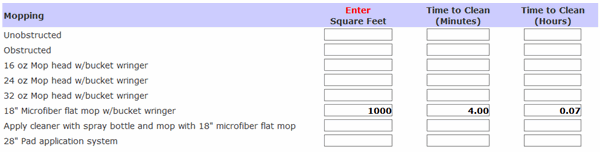
It can also be used in conjunction with self-determined production rates to evaluate a company's rates compared to industry averages. If the industry average for mopping a floor using an 18” flat mop is 4 minutes per 1000 square feet but it takes your cleaners, on average, over 10 minutes, there is definitely something wrong and a need for improvement. Perhaps the pads need laundered or replaced, using dirty water, or cleaners are using insufficient cleaning procedures and routes.
Comprehensive employee training and supervision, investing in new equipment, developing practical cleaning routes, and incorporating team cleaning regiments can pay big dividends when it comes to improving production rates.
Do your own time studies to estimate production rates for your facilities
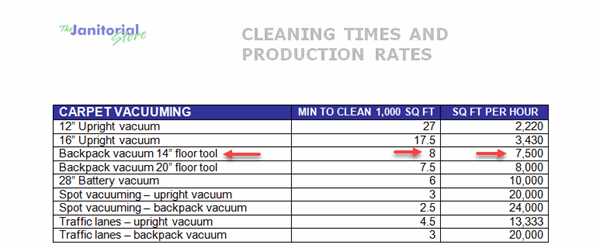
A production rate can be determined by counting the number of fixtures or the square footage of surfaces, such as carpet and tile flooring. Simply put, if it takes you 8 minutes to vacuum 1000 square feet of carpeting using a backpack vacuum with a 14” floor tool, and the building has 5000 square feet of carpeting, it will take you 40 minutes to complete the vacuuming task per service. If the building is to be cleaned 3 times a week, you will have 2 hour of labor each week for this task alone.
Although production rate benchmarks can be useful information; you will probably find that your own cleaning company production rates may differ from the industry standards. The best way to derive production rates for your company is to perform your own time study; meaning, time your employees or yourself performing different cleaning duties and document the production rates for each.
From the example above, you have determined that using a backpack vacuum with a 14” floor tool, you can clean 1000 square feet of carpeting in eight minutes. That means you can clean 7500 square feet of carpeting every hour (60 minutes/8 minutes = 7.50x1000 = 7500). Viola, you have just determined your own company's production rate.
The chart below is a sampling from The Janitorial Stores 'Cleaning Times and Production Rates' document.
Remember, that although you have pre-determined your vacuuming production rate using a particular type of equipment, those variables can throw that number off. If the building is jam packed with cubicles, tables, and office equipment, your production rate will suffer. Just another reason why it's imperative to perform a building walk-through of every facility you will be submitting a proposal for. No two will ever be exactly the same.
Developing your own standards will help you to bid more precisely and determine profitability more accurately. Here are some tips for creating a cleaning production rates standard for your company:
- First, create a specifications list of the tasks you'll be bidding on. Perhaps your list will include: emptying trash, cleaning restroom fixtures, dusting, mopping, and vacuuming with a back pack vacuum.
- Next, time yourself performing each of these tasks in a customer's building. Try to perform the same task at least three times, and then divide that number by three to get your median production rate.
- If you have employees, time several of your best workers performing each of these tasks as well. If possible, don't let them know you're timing them. People tend to work quicker if they know they're being timed, and you want your numbers to be as accurate as possible.
- Tally up all the times by task and figure out the average rate.
Let's run through an example. Perhaps you want to see how long it takes to clean a restroom with one sink, one urinal, and two toilets. Note: It is recommended that you tally the time for mopping and filling supplies separately.
Below are the results of your tested cleaning times:
Custodian #1 - 12 minutes
Custodian #2 - 13 minutes
Custodian #3 - 10 minutes
Custodian #4 - 13 minutes
Custodian #5 - 11 minutes
Custodian #6 - 11 minutes
Total Time: 70 minutes
70 minutes divided by 6 custodians = 11.7 minutes per restroom (excluding filling supplies and mopping).
Now you want to figure out how much time it took to clean each fixture. 11.7 minutes divided by 4 fixtures = 2.9 minutes per fixture.
If you'd like to figure out how long it takes to mop a restroom floor, then tally up the average times, and divide by the square feet. For example, if it takes 6 minutes on average to mop a 500 square foot floor, take 6 divided by 500 = .012 (.012 minutes per square foot). This equals 12 minutes per 1000 square foot (.012 x 1000). If you're working on a proposal that has 2500 square feet of floor that needs to be mopped, then you know it will take 30 minutes to mop the floor (12 x 2.5).
It's a good idea to review your rates for each of your customers' buildings at least once a year and continue to test production rates for new buildings as well. Creating your own production rates for your cleaning company can be a time-consuming process, but will provide you with valuable insight into your labor costs. And your labor costs will be a substantial portion of the building's overall costs.
An added benefit of doing your own production rates is identifying opportunities for additional employee training. You may uncover your low performers so you can give them more training to improve their rates, thereby improving your profits.
Production rates are simply how much time you expect your cleaning technicians to complete different tasks using specific tools and equipment. Understanding, monitoring, and continually trying to improve upon your company's production rates will help you to lower labor costs and improve profitability.
Copyright The Janitorial Store. All Rights Reserved
Visit our Store for Certification Training Programs





