

Training Cleaning Technicians When You Have a Language Barrier

Cleaning is a profession known for modest pay and hard work, so it's no wonder that many BSCs struggle to find and keep reliable and trustworthy crew. And it's only becoming more difficult thanks to growing demand.
One way contact cleaning companies deal with the hiring squeeze is by employing more immigrants. Immigrants now make up about 17% of the U.S. workforce.
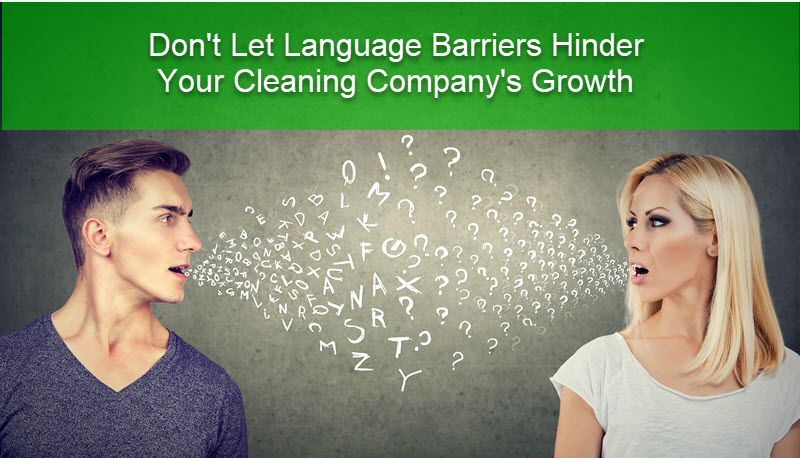
About half of immigrants speak proficient English, which means just as many do not. This can present language barriers for BSCs, who must ensure their crews can effectively, efficiently, and safely perform their jobs.
OSHA requires employers to provide safety training information to all employees. Ignoring language issues could be costly if a non-English speaking worker is injured on the job. Language barriers are a contributing factor in 25% of job-related accidents. This is an issue in many types of jobs, but especially the cleaning industry where employees work with hazardous chemicals and potentially dangerous equipment.
Clearly, it makes business sense to take proactive steps to ensure all workers, regardless of native tongue, are properly trained.
Before reading the rest of the article, watch Jean Hanson's interview with recruiting expert Patty DeDominic. If you've been resisting hiring employees due to a language barrier, you're missing out on a big opportunity to grow your work force with hard working, loyal employees.
Language Barrier Tip #1: ESL Programs
Although not a quick fix, helping employees learn English can eventually pay off. Some innovative companies pay for non-English speakers to attend English as Second Language (ESL) classes outside of work hours. Others hire a teacher to provide English training in-house.
This can be a costly benefit and, as always, there will be some employees who abuse it. Even so, learning even basic English vocabulary can go a long way in reducing potential worker compensation cases. If possible, customize the learning experience to focus on words relevant to your janitors' work.
Also, there's a good chance many of your staff will speak the same foreign language. Spanish is by far the largest non-English language spoken in the U.S. (followed distantly by Chinese). In this case, it may also be worthwhile to pay for key supervisors to attend Spanish classes.
Language Barrier Tip #2: Training Techniques
People learn best when they are taught in their native language. Comprehension also increases because they aren't having to mentally translate information between languages. ESL is a long-term solution, but how do you make sure employees are well-trained before they become fluent in English?
One option is to purchase training materials that are written or recorded in the learner's native language. This also includes things like SDS sheets, safety manuals, and tasks checklists. If you have proprietary training programs, you could pay a translator a one-time fee to convert the materials into another language.
A bigger investment is hiring an interpreter to help communicate during trainings. Some companies are able to rely on bilingual employees to perform this task (in these cases, consider paying these workers a premium for their efforts). Although pricey, this is the best way to ensure workers are able to ask questions and receive clarifying responses they are sure to understand.
Whether you get translation help or not, it's important to change your approach to training when you are working with immigrant workers. Make your communication more visual and less verbal. Don't have trainers stand in front of the room and read papers and don't sit employees in front of a video with a talking head speaking the entire time.
Use pictures, like flash cards and signs, and demonstrations whenever possible. Show proper techniques and how to operate equipment, and then let them do it themselves while you observe. Repeat until you are certain they understand and are able to properly perform a task.
Language Barrier Tip #3: Use Smart Software
English-speaking managers may speak too quickly or use colloquialisms and jargon, all of which can cause confusion for non-English speakers. Using janitorial software can help in post-training communication with all employees.
Many software makers allow users to switch languages with the push of a button. You could upload SDS sheets and warning labels and share them with employees in their native languages. Some janitorial software also includes a messaging app that allows for translated communications.
If your software doesn't have these functions or if you don't use such a program, you can use Google Translate to convert instructions into various languages. Also, you can use photos of tasks (customized by location) and include them with a translated checklist to better explain acceptable procedures and quality levels.
Language Barrier Tip #4: Color Coding
Color-coded products, which cost about the same as regular products. can also be helpful in dealing with language barriers.
There are color-coded equipment, tools, microfiber, and signs. The colors typically represent danger (red), caution (orange), a lesser degree of caution (yellow), safe (green), and glass cleaner (blue). Although this is a fairly standard understanding of the various colors, it is not universal.
Also, OSHA requires every company that uses hazardous chemicals to have a Hazard Communication Program in place. One element of this program is having pictograms on labels to alert users of the chemical hazards to which they may be exposed.
Each pictogram consists of a symbol on a white background framed within a red border and represents a distinct hazard(s). The pictogram on the label is determined by the chemical hazard classification.
These labels can be useful in helping non-English speaking workers understand the risks of the products they are using. Of course, it's essential that employers train their employees on what the pictograms are and what they mean.
A contract cleaning company must make sure its employees feel safe and are confident in how to do their jobs. If you hire workers who are not proficient in English, then you must find ways to accommodate them. By helping a cleaner overcome a language barrier, you will likely find yourself with a grateful and competent employee.
Ebook Download: The Secret to Recruiting and Retaining Millennials
|
|
Millennials have overtaken Baby Boomers and Generation X as the largest share of the American workforce. More than a third of employees are 20 to 36 years old, and it will reach 50% in the next three years and 75% by 2025. If you're not hiring Millennials yet, download the ebook for best practices on recruiting and retaining this growing workforce. |

Visit our Store for Certification Training Programs





