

Medical Cleaning and Dealing with its Unique Challenges

Looking to boost profits, many cleaning companies are pursuing the medical industry as an area for expansion. More and more hospitals and medical offices are outsourcing cleaning, and savvy BSCs are jumping on the opportunity. While medical cleaning can be lucrative, it's important to understand the unique challenges presented by cleaning for the healthcare industry.
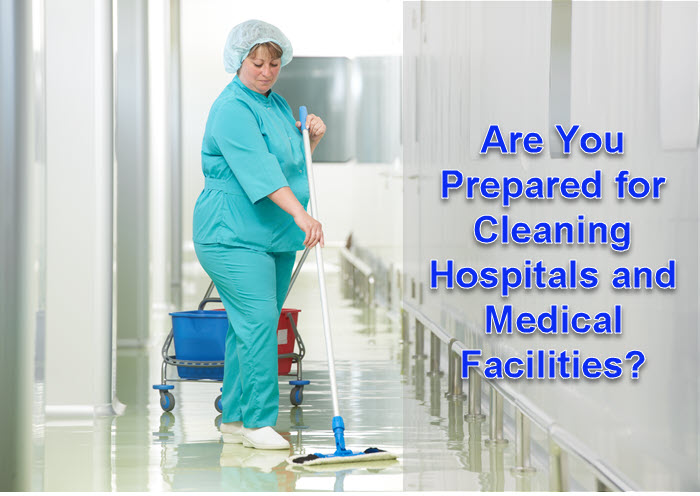
Medical Cleaning Challenge #1: Staff Safety
Medical cleaning presents a higher risk for cleaning technicians. While employees may encounter nasty germs and bodily fluids when cleaning Class A offices; it's guaranteed they will in medical cleaning.
Cleaning technicians working in medical settings are exposed to more harmful pathogens than the average person. It's imperative staff members entering this environment are properly trained to protect themselves and minimize the risk of contracting an illness. Personal Protective Equipment (PPE) like latex or nitrile gloves are among your technicians' most important tools.
If you contract with a medical provider's office, your staff must be well-trained in the risks associated with bloodborne pathogens and other illnesses they may encounter in their daily work. For a more detailed look at these concerns, our DVD, Bloodborne Pathogens Training for Janitorial Employees, provides a great overview (or, when you join Premium Membership, this video training is online and included with your membership plan).
Medical Cleaning Challenge #2: Strict Regulations
Your clients likely have preferences for how you clean their spaces, but medical offices have extremely strict regulations they (and their contractors) must follow.
Unlike technicians working in other types of facilities, hospital cleaners need to follow precise rules based on information from the Centers for Disease Control (CDC) and the Association of periOperative Registered Nurses (AORN). These organizations put a lot of resources into studying how to best limit disease transmission and keep healthcare employees safe. There are also Occupational Safety and Health Administration (OSHA) regulations for exposure to bloodborne pathogens.
These rules may require changes to your processes and equipment. As an example, a vacuum cleaner that isn't properly filtered can blow viral and bacterial pathogens into the air, increasing the risk of infection for cleaning technicians, patients, and healthcare workers. A healthcare facility may limit your staff's access to different parts of the building or require you to use specific equipment.
Medical Cleaning Challenge #3: Patient Privacy
The Health Insurance Portability and Accountability Act (HIPAA) is a nationwide law that requires strict privacy restrictions in the medical industry. Although contract cleaners aren't specifically required to follow HIPAA, most medical offices expect their contractors to understand (and perhaps follow) patient privacy laws.
HIPAA mistakes can be extremely costly. A few years ago, Affinity Health was fined over $1.2 million after removing their photocopiers from the building without first wiping the hard drives. With such steep consequences, you may notice that medical providers are much more involved in your staff's day-to-day routine. Your staff may be restricted from accessing certain areas without supervision or required to undergo more stringent background checks than you'd require for a technician cleaning a lower-risk business.
Medical Cleaning Challenge # 4: Staff Mistakes
With your current clients, your main objective is likely to simply remove soil and tidy the space. Medical cleaning is much more intensive. The average hospital patient has a much weaker immune system than the average person. This means issues in sanitizing or disinfecting areas could have dire consequences for patients. Technicians need to understand that the surfaces they clean may be covered by dangerous, infectious pathogens.
In an office building, your technicians might not disinfect every single door handle in the building during every service. They focus on restrooms, public areas, and high-traffic spots. These types of shortcuts aren't safe in a medical setting. To prevent the spread of germs, your technicians need to disinfect every surface that might harbor infectious bacteria and viruses.
Medical Cleaning Challenge #5: Theft Risks
Employee theft in the healthcare industry has higher stakes than in other types of facilities. Hospital patients, elderly nursing home residents, and people distracted by concerns for a family member's health are highly vulnerable to theft. Many people report theft of small, easy-to-conceal items like jewelry or credit cards during their stay at a healthcare facility.
Larger items are also susceptible to employee theft. VA Hospital officials in Indiana estimate that over $1 million dollars worth of equipment and inventory (around 1% of their total assets) goes missing every year; much of this loss is attributed to theft by employees and outside contractors.
Most concerningly, a large number of prescription drugs go missing from medical facilities. Although your cleaning technicians won't be given the keys to medication cabinets, it's nonetheless an issue for BSCs to understand.
Mayo Clinic recently audited incidents of opioid theft and most was committed by the staff responsible for inventorying or administering the drugs. That doesn't mean BSCs can ignore the risk that a sly staff member could use their position to commit this felony. According to the Mayo Clinic report, A night custodian was discovered rummaging through sharps waste containers holding nearly empty vials of fentanyl. On questioning, the custodian revealed that he had been withdrawing and consolidating the miniscule remaining fentanyl from each vial, which he later self-injected to support his addiction.-
Medical cleaning is a profitable area for many cleaning companies to consider. Before you begin pitching to new prospects, however, make sure you and your team can handle the unique challenges presented by the healthcare setting.
Copyright The Janitorial Store. All Rights Reserved
Certified Safety Training for Janitorial Employees
Janitorial safety training must be a priority in your cleaning business. Not only is it your responsibility to keep your employees safe, but paying added Worker's Compensation fees due to your own lack of training just does not make good business sense.
Buy the Training Program and learn how to use it to get Certified!
Visit our Store for Certification Training Programs





