

The Leadership Test: Are You Making These Leadership Mistakes?

At a recent leadership conference, we started out with a quick exercise that took us back to the days of working for someone else. For us, we had to go WAY back! But it helped us visualize whether we were making several common leadership mistakes in our management style. We made 2 columns on a sheet of paper, titling the left side “Best Boss” and the right side “Worst Boss”.
In the “Best Boss” column, we listed qualities and behaviors of bosses we've respected, appreciated and admired.
In the “Worst Boss” column, we listed qualities and behaviors of managers we've disliked, dreaded and held little respect for. Below are some of the things I listed on my sheet.
Best Boss vs Worst Boss
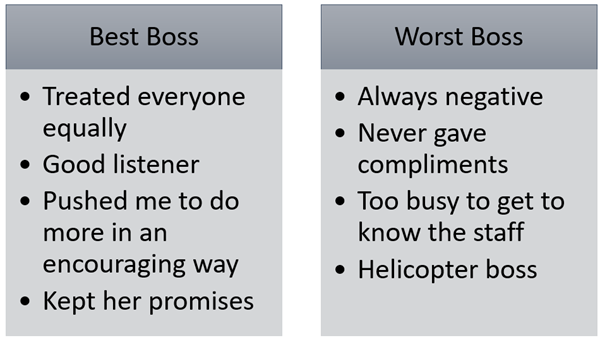
I'm sure you can see where I'm going with this exercise. Are you already looking at the qualities listed and rating yourself on each? Do you treat everyone equally? When was the last time you gave a compliment?
Do this exercise yourself, and think back to when you were in the workforce working for other people. Then take the list and force yourself to take a hard look at your own leadership style. Be honest with yourself and hi-light those areas you need to improve upon.
Once you've done this yourself, take the next step and ask your employees to do the same exercise. The reason to have your employees do this is so that you can gain insight into how they want to be managed.
Now that you know what they look for in a good boss, do a self-inventory to see how you can model those qualities. On the flip side, take a look at the list below to see if you're making some of the 5 biggest leadership mistakes.
5 Biggest Leadership Mistakes
- Micromanagement – Also known as the “helicopter boss”, the micromanager is constantly correcting and making “suggestions” on how to do it better. Intentions are good because you have the experience and want them to do it as efficiently as possible. But you could also be sabotaging their engagement and desire to show you what they can do. In effect, you're grooming them to become dependent on you to direct their daily tasks – exactly what you DON'T want since that doesn't free up your time, and keeps them from learning and growing.
- Abdication – This is the opposite of micromanagement. I know so many cleaning business owners that are always in urgency mode, trying to fill open positions. When they finally find a good prospect that ticks all the boxes, they hurriedly onboard them, spend a day working with them on site, and then leave them to take care of the cleaning much too quickly. When you dump a project on an employee or onboard them without adequate training, you are leaving them to figure it out for themselves. This sets them up for failure and sets you up for frustration, wondering why it wasn't done right.
- Trust violations. Good leaders are trustworthy. It's one of the qualities most admired by good employees. Violating their trust erodes loyalty, and without loyalty there is nothing to keep them from moving onto the next job.
Examples of trust violations include:
* Letting poor performing employees slide (other employees are watching)
* Not keeping your word (I'll get that vacuum fixed for you tomorrow)
* Being late for meetings (why should I be on time when the boss doesn't show up on time?)
* Not meeting deadlines but expecting employees to meet theirs (model the behavior you expect) - Not Taking the Time to Know Your Team. Some of you keep information on your clients such as birthdays, children's names, favorite sports and leisure activities. Are you doing the same for each of your employees? It doesn't take a lot of effort to find out what matters to each member of your team. Besides personal details, observe what motivates them. Talk to your managers and supervisors to find out what brings out the best (and worst) in them. Then use that information to connect with them. This goes hand in hand with #5 below.
- Rushing with Your Team. You're busy… I get it. We're all busy. But instead of rushing around, saying a quick “Hi” as you whiz by an employee, slow down and take a couple minutes to connect with your employees. Most employees do not want to carry on long conversations with you, but they do appreciate being acknowledged by the boss and interacting with him/her. It only takes a few minutes to connect with them – take the time. You'll increase engagement and loyalty.
Being a good leader takes time and takes practice. If you realize you have work to do with your own leadership style, then doing this exercise is a good way to get started. Identify one mistake you're making and start working on a plan for improving. Over time, your employees will notice, and your business will improve at the same time.
Visit our Store for Certification Training Programs